Wishful thinking: RFA targets for Rangers, including Jason Robertson

The New York Rangers have plenty of money to spend when free agency opens on July 1 – nearly $26.6 million, according to PuckPedia. They desperately need impact players. But the market is tight: Alex Tuch, Bobby McMann and Mason Marchment are arguably the best of a middling group of unrestricted free agent forwards who are good complementary players but not premier talents.
There’s a lot more talent available among restricted free agents. But dreaming about signing a 40-goal scorer like Jason Robertson or a franchise center like Connor Bedard is one thing. Actually doing it is a lot harder.
Signing most RFAs means more than just spending money; it also means doling out draft pick compensation if the player’s team opts not to match the offer. The compensation depends on the money involved – signing a player for a contract with an average annual value of less than $1,544,424 costs nothing; a player who signs a deal with an AAV of more than $11,700,193 will cost four first-round picks — all of which must be the signing team’s own choices.
That’s a big reason NHL teams don’t make a lot of RFA signings; there have been just 12 since the start of the 21st century. The most recent came in 2024, when the St. Louis Blues signed defenseman Philip Broberg and forward Dylan Holloway away from the Edmonton Oilers. The combined cost was a second-round pick and a third-round selection in the 2025 draft.
The Rangers signed two such players in the 1990s but didn’t get either. The Detroit Red Wings matched New York’s five-year, $2.5 million AAV to enforcer Stu Grimson in the summer of 1995. The Colorado Avalanche did the same two years later when the Blueshirts signed star center Joe Sakic to a front-loaded three-year contract with a $7 million AAV that would have paid him $15 million in his first season.
The Blueshirts are somewhat limited because they lack their second-round pick in the 2027 draft, which went to the Pittsburgh Penguins on July 1, 2024, in a deal that brought forward Reilly Smith to Broadway. Unless they reacquire the pick, the Rangers won’t have the resources needed to sign players within the $2,387,833-$4,775,666, $7,163,499-$9,551,332 and $9,551,333-$11,939,166 brackets. In that case, they can try to work out a trade if the player is someone GM Chris Drury and coach Mike Sullivan really want.
Here are three RFAs that, for different reasons, Rangers fans can dream about adding — though the likelihood of actually seeing any of them on Broadway this fall is incredibly slim. Note that we’re not including rising stars like Bedard of the Chicago Blackhawks and Leo Carlsson of the Anaheim Ducks, who are sure to stay with their respective teams.
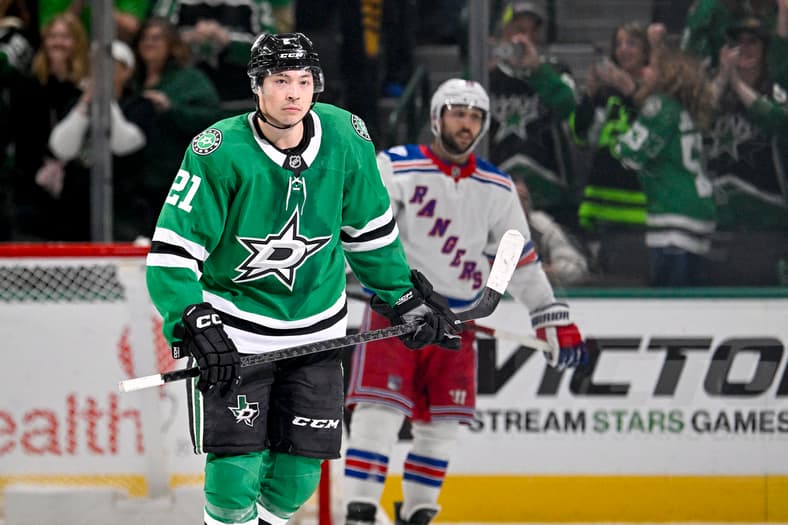
Jason Robertson (Dallas Stars)
2025-26 totals: 45 goals, 51 assists, 96 points
Likely contract AAV: $12 million-plus
Robertson had more goals and points than any other RFA this season, so re-signing him is a prime objective of Stars GM Jim Nill. But it won’t be easy: Dallas has just over $10 million in available salary cap space, according to Puckpedia, and Robertson is said to be looking for more than Mikko Rantanen, who’s entering the second season of an eight-year contract with an AAV of $12 million.
The 26-year-old forward is a three-time 40-goal scorer, a feat accomplished only by Mike Gartner in the Rangers’ 100 seasons. He would give the Rangers a top-line forward who can drive play and is still in the prime of his career.
If Robertson gets to free agency, he’d undoubtedly cost any team that wants to sign him four first-round picks in the five-year span from 2027 to 2031 in addition to the big contract. That’s a huge price.
It’s more likely that if the Stars and Robertson can’t reach a deal, Nill will see what he can get in a trade. The Stars’ window of contention is wide open, and the Rangers wouldn’t appear to have the talent to match potential offers from rival teams – Dallas would likely want top-level prospects, roster players and draft picks.
If the Stars keep Robertson, it could open the door for the Rangers to pursue forward Mavrik Bourque either through an offer sheet or trade. He’s 24, coming off his first 20-goal season — and a lot cheaper to acquire and retain.
Pavel Dorofeyev (Vegas Golden Knights)
2025-26 totals: 37 goals, 27 assists, 64 points
Likely contract AAV: $7 million-plus
Dorofeyev is a big reason the Golden Knights are in the Stanley Cup Final for the third time in their nine NHL seasons. But he doesn’t get the kind of recognition accorded to teammates Jack Eichel, Mark Stone and Mitch Marner. All he does is put the puck in the net a lot — the kind of player the goal-starved Rangers could really use.
The 25-year-old followed last season’s 35-goal breakout with 37 goals this season, then scored 10 times in the first three rounds of the Stanley Cup Playoffs. That put him in line for a huge payday as an RFA.
He’s also shifting perceptions that he’s a one-dimensional scoring wing. Entering the Stanley Cup Final against Carolina, Dorofeyev was plus-5 and the Golden Knights had a 1.46 goals-against average per 60 minutes with him on the ice.
Vegas has about $13.4 million in cap space (assuming defenseman Alex Pietrangelo has to sit out another season with injury) and wants to re-sign defenseman Rasmus Andersson, a late-season trade acquisition, as well as Dorofeyev. But short of getting next year’s second-rounder back from the Penguins, the Rangers would likely have to have to work out a deal with Vegas to get Dorofeyev. It’s hard to imagine that happening.
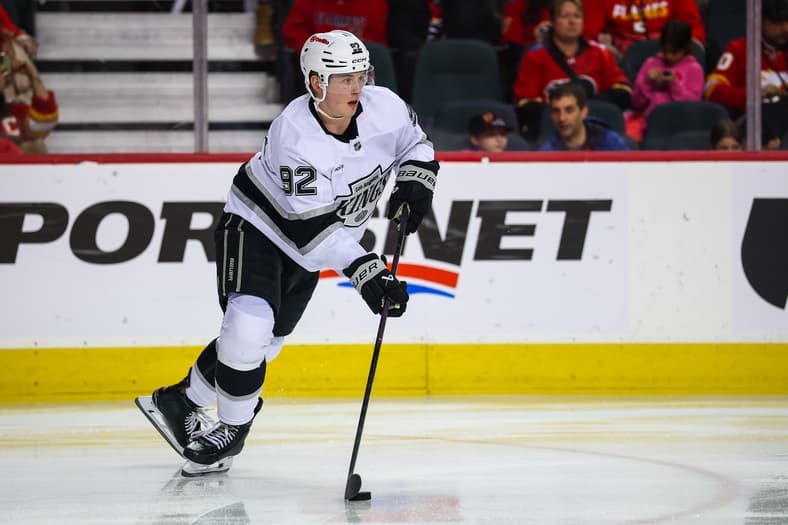
Brandt Clarke, Los Angeles Kings
2025-26 totals: 8 goals, 32 assists, 40 points
Likely contract AAV: $4 million-$6 million
The eighth player chosen in the 2021 draft is coming off the best of his three NHL seasons and coming into his own as a top-level defenseman as he reaches RFA status. He’s said he wants to remain with the Kings but still hasn’t signed a contract.
He’ll no doubt get a raise from his 2025-26 salary of $863,334. The question is how big a raise — and for how long.
Clarke has the talent to be a first-pair defenseman. His straight-line speed isn’t top-end, but his lateral movement and edge work are excellent. He sees plays that others don’t — and has the confidence to make them.
A 23-year-old right-shot defenseman with Clarke’s talent and future is the kind of player any team would want — even one that has a premier blueliner like Adam Fox. If he doesn’t re-up with the Kings, Clarke could be another trade candidate to pursue.