New York Rangers report cards: Why coach grades higher than GM

No matter how you slice it, the 2025-26 season was an absolute failure for the New York Rangers.
They finished last in the Eastern Conference and 30th overall in the NHL with a 34-39-9 record, and their 77 points were fewest for the franchise in a non COVID-shortened season since 2017-18 (also 77 points).
The Rangers started 0-6-1 at Madison Square Garden, shut out in five of those first seven home games. Their 14 home wins were fewest in a full 82-game season since 2003-04, when they won 13 times at MSG.
Worse is that they missed the Stanley Cup Playoffs for the second consecutive season, after a stunning faceplant in 2024-25. They were supposed to be better this season, and instead were actually worse.
So, let’s kick off our end-of-season Rangers report cards at the top of the organizational food chain, handing out grades to general manager Chris Drury and coach Mike Sullivan.
Chris Drury: D
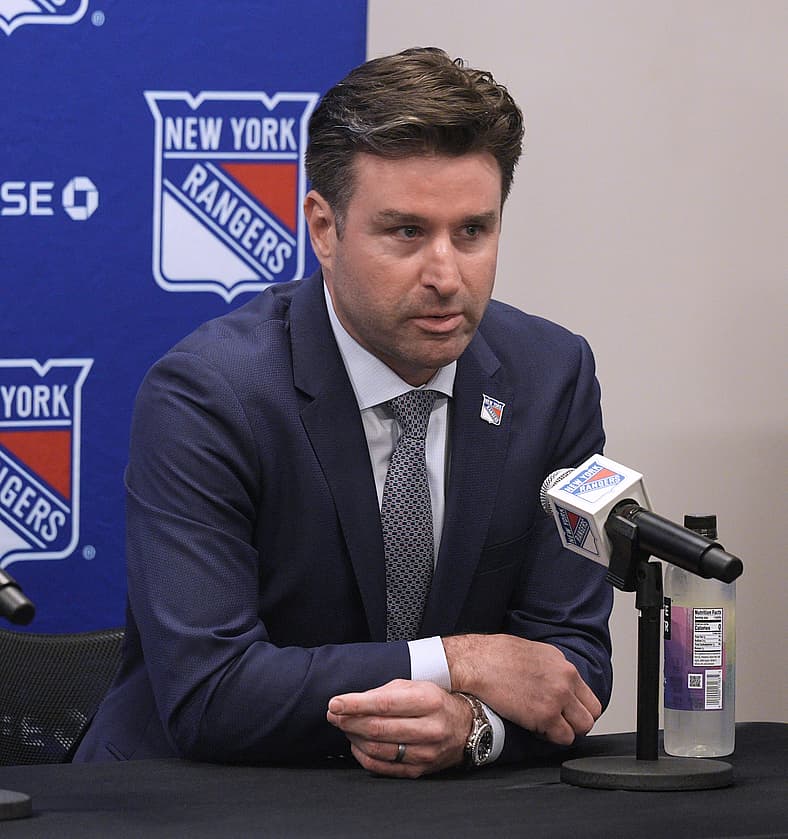
Drury dismantled the roster of a Rangers team that was two wins away from reaching the Stanley Cup Final in 2024, largely to create salary-cap space, and to remake a core that he believed wasn’t mentally or physically tough enough to win a championship. However, he didn’t adequately backfill throughout the organization, and the Rangers paid the price for that this season.
The Rangers didn’t have nearly enough talent at the NHL level nor in a very thin prospect pool. They averaged 2.87 goals per game, 23rd in the League and a major drop from the year before, when they ranked 12th and scored 3.11 goals per game. New York was shut out 10 times on the season, and really struggled at even strength, where they were outscored 190-175. Simply not enough skill nor production from the roster Drury built.
Their lack of organizational depth was exposed when injuries struck this season, in particular in January when No. 1 goalie Igor Shesterkin and top defenseman Adam Fox sustained lower-body injuries in the same game and were sidelined until after the Olympic break in February. They lost 11 of 13 games in that stretch, submarining any chance the Rangers had of remaining in the tight Eastern Conference playoff race.
They embarrassingly sunk to the bottom of the standings with a roster largely constructed by Drury in his previous five years as GM. So, Drury went to a favorite script from the Rangers playbook, sending a letter to the fans to explain changes were coming, a retool — not rebuild — was in effect, and younger players would be coming in to replace veterans and stars. It all sounded noble and sensible. Outside of Rangers owner James Dolan, though, who actually trusts Drury to pull off a successful makeover here?
There aren’t a lot of winning trades or draft picks or player development the past couple years under Drury, despite the emergence of 2023 first-rounder Gabe Perreault, a nice first nine NHL games by defenseman Drew Fortescue, and some juice provided by rookies Dylan Garand, Adam Sykora, and Jaroslav Chmelar down the stretch. And give Drury credit for signing Vladislav Gavrikov to a seven-year, $49 million contract last summer. The veteran defenseman had a helluva first year on Broadway. And let’s see how Liam Greentree develops before we fully judge the Artemi Panarin trade with the Los Angeles Kings.
Basically this season deserves an all-around F grade, and Drury shares a large portion of the blame for that. However, he repaired his terrible relationship — of his own doing — with the players, and appeared to learn from his trove of previous mistakes as it pertained to communication and respect. He gets high marks for hiring Sullivan as coach, and stealing forward Tye Kartye away from the Seattle Kraken on waivers. Plus, his 2025 draft class, led by Michigan forward Malcolm Spence, might end up being pretty good by the look of things, so far.
So, for the second straight crappy season, Drury barely escapes an F on his report card.
Mike Sullivan: B-
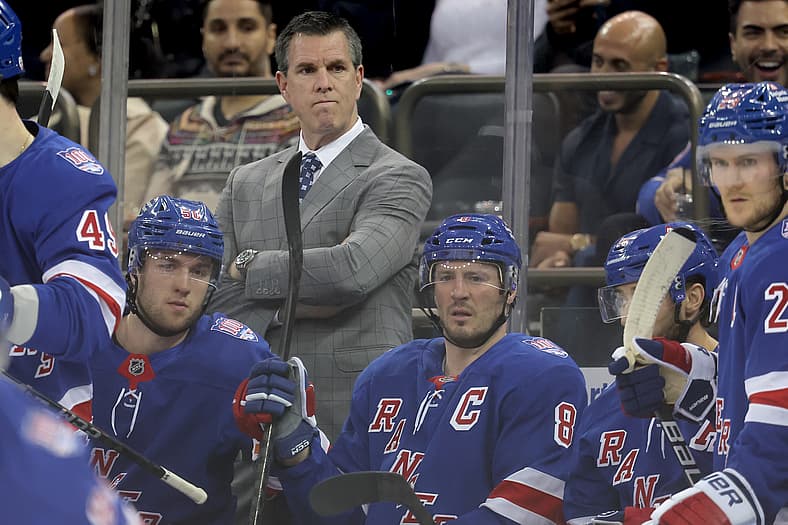
As coach, Sullivan takes his share of the blame too. But he inherited a shallow roster and helped keep this team in the playoff hunt until it all came undone in January. His biggest accomplishment is that the Rangers played consistently hard and with effort this season, a low bar that was not met often enough in 2024-25. That the Rangers played well after the Olympic break and didn’t throw in the towel despite their standing in the League, also speaks to Sullivan’s leadership.
There’s no question the players respect Sullivan, a two-time Stanley Cup winner with the Pittsburgh Penguins, and gold-medal winning coach of the United States at the 2026 Milan Cortina Olympics. Yes, he has that gravitas. But he earned this team’s trust with excellent communication and honesty, as well. It was something this group badly needed, and it began in his first few weeks as coach a year ago, when he traveled to Sweden for a personal one-on-one with disgruntled veteran Mika Zibanejad. Not only did he win Zibanejad over, but it helped spark a resurgent season by the star center.
His messaging also broke through to Alexis Lafreniere, who emerged as a productive force and consistent net-front presence after the Olympic break.
Sullivan’s messaging was clear and on point throughout the season. His systems worked, in part because there was buy-in throughout the lineup. It’s not his fault that the Rangers couldn’t score at home early in the season, and throughout other stretches in the schedule. The Rangers lost plenty of games this season when the eye test and underlying metrics told you they were the better team. That said, there needs to be more North-South in their game, and the Rangers must simply get more shots on net — they averaged 25.2 shots on goal, next to last in the League.
Defensively, the Rangers played with far more structure in their own end and neutral zone than the season prior. Shesterkin said — perhaps half kiddingly — that Gavrikov’s presence alone turned things around defensively. But Sullivan and his staff deserve credit for that, as well as for helping turn the power play back into a force after a one-year dumpster fire. The Rangers finished fifth in the NHL with a 24.7 percent conversion rate on the power play this season. As it’s been said of even better Rangers teams in the recent past, they just didn’t score enough at even strength.
Sullivan expertly brought along rookies Perreault and Noah Laba, and by season’s end it was clear each should be a long-term fixtures in the lineup. He got the most out of Sykora and Chmelar late in the season, and perhaps they can be bottom-sixers moving forward. Rookie defenseman Matthew Robertson established himself as a dependable NHL regular under Sullivan’s watch, too.
But it didn’t wok out great with youngsters like Scott Morrow, Brett Berard, nor Brennan Othmann (since traded to the Calgary Flames). But again the messaging was clear: if you can’t be trusted defensively, you won’t play for Sullivan’s Rangers.
The coach navigated Fox’s exclusion from the U.S. Olympic roster as best as can be expected. And his Olympic duties nor success in Italy never seemed to divert attention from his day job with the Rangers.
Did he stick with favored veteran Conor Sheary longer than he should have or at the expense of younger players — even if the forward came alive late in the season? Yes, he did. But if that’s among his most egregious mistakes, then that’s not so bad, right?
Most importantly, it looks and feels like the Rangers have the right coach, which says a lot considering their last-place finish in 2025-26.