Should Rangers sign Gabe Perreault to extension sooner rather than later?

The New York Rangers don’t have to decide on Gabe Perreault’s future today. But after watching the Leo Carlsson offer sheet drama, Rangers general manager Chris Drury may want to start thinking about Perreault’s next contract and long-term future sooner rather than later.
When the Philadelphia Flyers extended a whopping five-year, $90 million offer sheet to Carlsson earlier this month, it sent shockwaves around the NHL. Anaheim eventually matched the deal to keep its franchise center, but the message sent was clear: waiting to until a young star reaches free agency comes with significant risk these days.
Perreault isn’t Carlsson, and this isn’t to suggest the Rangers should hand him a massive extension tomorrow. In fact, there’s a glaring reason not to. Perreault has just 54 games of NHL experience, hardly the sample size that warrants a long-term commitment.
By comparison, Carlsson’s already played 201 NHL games over three seasons, recorded 141 points, and was the No. 2 overall selections in the 2023 draft, 21picks ahead of Perreault.
But with the salary cap projected to rise to $113.5 million in 2027-28 and the Rangers expected to have nearly $36 million in cap space, per PuckPedia, when Perreault becomes a restricted free agent, it’s fair to ask whether the organization should start thinking about an extension.
The money, at least on paper, isn’t the difficult part.
The Rangers will have decisions to make on restricted free agents Will Cuylle, Matt Rempe, Noah Laba, and Jaroslav Chmelar, as well as veteran UFAs Oliver Bjorkstrand, Taylor Raddysh, and Joe Veleno next summer. No one’s breaking the bank in that group; and Bjorkstrand and Veleno were signed this summer to one-year deals, largely to be placeholders for the next wave of young Rangers talent.
The bigger question is whether Perreault has shown enough to justify getting ahead of the process. Signing a player before he even reaches restricted free agency means paying for what you believe he’ll become. Which brings us to the biggest argument against an early extension.
Is the sample size enough?
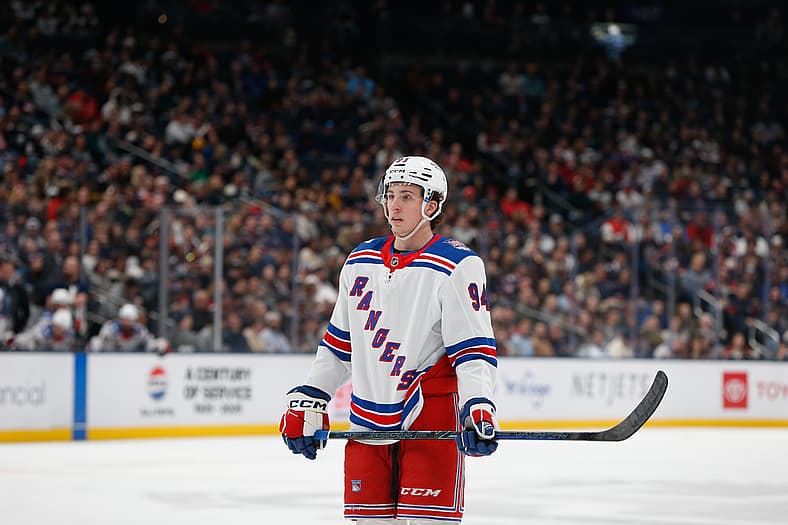
After beginning last season — his first full pro campaign — in Hartford and bouncing between the AHL and NHL early on, Perreault eventually earned a spot as a regular on the Rangers top line alongside Mika Zibanejad and Alexis Lafreniere. Once he settled in, the production followed. He finished the year with 12 goals and 15 assists for 27 points in 49 games, but his best hockey came down the stretch. Over his final 23 games, Perreault recorded nine goals and 10 assists, highlighted by his first career hat trick, looking more and more like a player capable of becoming a long-term piece of the Rangers core.
So on one hand, Perreault looked every bit of a future top-six winger during stretches of his first full NHL season. On the other hand, 54 games — including five at the end of the 2024-25 season after his sophomore year at Boston College — is still 54 games.
Betting on the future

The Rangers wouldn’t be the first team to wrestle with when to lock up a young player, though.
The Montreal Canadiens moved quickly with Juarj Slafkovsky, signing the 2022 No. 1 overall pick to an eight-year, $60.8 million extension after he played 121 NHL games and recorded 60 career points. The Canadiens believed his trajectory was worth investing in before his price climbed even higher.
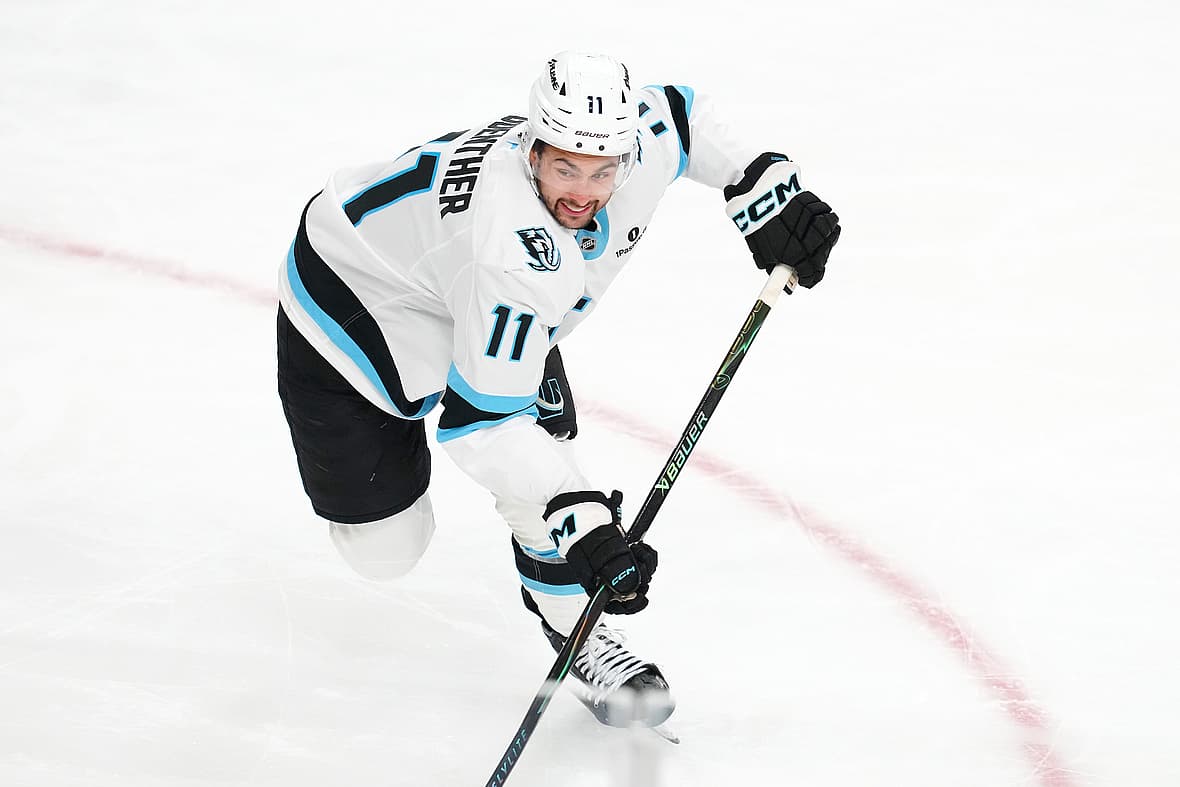
A similar decision was made by the Utah Mammoth with Dylan Guenther, the No. 9 overall pick in the 2021 NHL Draft. After just 78 NHL games and 50 career points, the Mammoth signed him to an eight-year, $57.1 million extension, betting on his upside instead of waiting for another breakout season.
But for every Slafkovsky or Guenther, there’s also a Jesperi Kotkaniemi. After luring the former No. 3 overall pick away from the Canadiens with a successful offer sheet, the Carolina Hurricanes signed him to an eight-year extension, believing he would develop into a top-line center. Instead, after posting a career-high 43 points in 2022-23, he followed it up with 27 and 33-point seasons before falling down Carolina’s depth chart. In 2025-26, he suited up in just 42 regular-season games and recorded nine points (two goals, seven assists). The 26-year-old didn’t play a single game during the Hurricanes’ Stanley Cup championship run in the postseason this past spring.
Kotkaniemi is still an NHL player. He can still kill penalties, play center, and fill a middle-six role. But that’s exactly the point. Carolina didn;t invest in him at the time for a serviceable third-line center. They banked on the player they believed he’d become, and that projection didn’t work out.
Learning from Lafreniere

The Rangers faced a similar decision not too long ago with Lafreniere, albeit under different circumstances. Following his breakout season in 2023-24 and terrific performance during the 2024 Stanley Cup Playoffs, the Rangers signed Lafreniere to a seven-year extension. Unlike Perreault, however, Lafreniere had already completed his entry-level contract and was on a two-year bridge deal, giving the Rangers a much larger body of work before pulling the trigger on a long-term deal. Lafreniere signed the long-term extension during his fifth NHL season.
But the point still remains. At the time, the move looked like a bargain. Lafreniere was coming off the best stretch of his NHL career, and the Rangers were betting that his postseason success would carry over into the regular season. But, he finished with 17 goals and 45 points in 2024-25, struggling to find any sort of consistency.
That doesn’t mean the contract is a bad one, though. In fact, Lafreniere looked much more like the player the Rangers envisioned during the second half of the 2025-26 season. He caught fire down the stretch with 28 points (14 goals, 14 assists) over his final 27 games, coincidentally finding chemistry, in part, with Perreault.
Choosing right approach with Perreault

So when it comes to Perreault’s future, Drury has three different paths he can take.
He could decide he’s already seen enough. If the Rangers believe Perreault’s 54-game sample is a true indication of the player he’s becoming, an early extension could look like a great deal in a few years from now, if he continues to develop as expected.
The Rangers could also take a more patient approach. Another half-season or even a full year of evaluation would give the Rangers a much larger sample size before committing to a longer-term deal. The downside, of course, is that if Perreualt continues to break out, every goal and every point strengthens his negotiating position and makes the next contract that much more expensive.
Then there’s the scenario that wasn’t on many teams’ radar until this summer. If Perreault reaches restricted free agency next summer without an extension, another club could decide to do exactly what Philadelphia did with Carlsson and force the Rangers into a hefty offer-sheet decision, with the potential of losing Perreault or having their budget thrown a bit out of whack
They’ll have a much better understanding of what kind of player Perreault is, but they also run the risk of paying significantly or allowing another team to dictate the negotiations.