Which Rangers Were Overpaid, Underpaid in 2025-26, including Miller, Gavrikov

The New York Rangers have no shortage of big-money contracts on their roster, but a new NHL salary model suggests that some of the Blueshirts may actually be outperforming their cap hits.
Benchrates recently launched an overpaid and underpaid player tool that compares a player’s cap hit to a “Power Score.” That’s a dollar value generated from a combination of traditional and advanced stats during the 2025-26 NHL season. The model then determines whether a player outperformed, underperformed, or matched the value of his contract.
The system incorporates goals, assists, expected goals, face-offs, and defensive metrics, among other stats. However, it does not account for things like age, contract length, leadership, and other qualities that can’t necessarily be measured through stats.
One important asterisk is that for players making less than $1 million annually, Benchrates compares their performance against the League minimum salary rather than their actual cap hit. As a result, young players on entry-level contracts tend to fare extremely well in this model. For that reason, Gabe Perreault and Noah Laba were both excluded from this list as they dramatically outperformed their entry-level contracts.
Using Benchrates’ new system, here are eight Rangers that stood out one way or the other based on their 2025-26 performance.
Overpaid
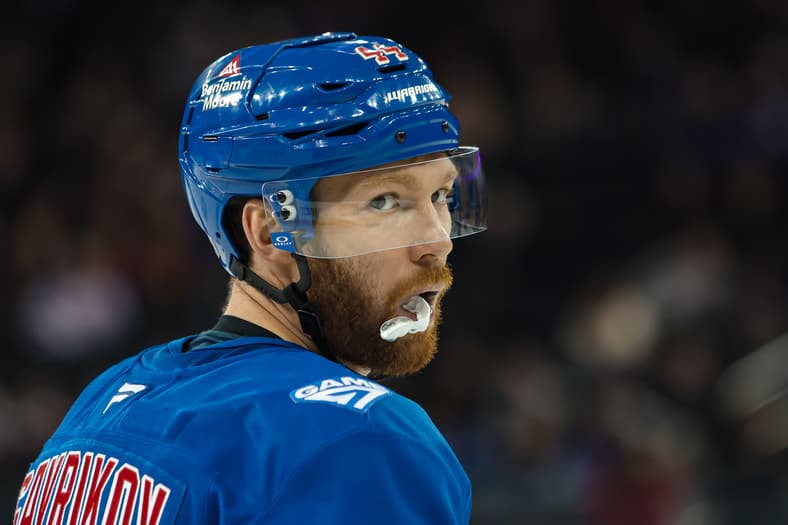
Only two Rangers players landed in the overpaid category according to Benchrates: Vladislav Gavrikov and Will Borgen.
Of the two defensemen, Gavrikov’s placement is definitely more surprising. In a season when much of the Rangers roster struggled to meet expectations, Gavrikov was one of the team’s bright spots. He played in all 82 games on the Rangers top defense pair, led the team in ice time, and set career highs with 14 goals and 35 points.
Benchrates calculated Gavrikov’s 2025-26 performance at roughly $4.7 million despite his $7 million cap hit. What the system can’t account for is the importance of Gavrikov’s role alongside Adam Fox or the difficult defensive assignments he handled on a nightly basis. The Rangers signed him to stabilize their top pair, and by most accounts, he delivered exactly that during his first season on Broadway.
On the other hand, Borgen’s rating is somewhat easier to understand. He played an important role for the Rangers, suiting up in 75 games as a second-pair staple and regular on the penalty kill. However, his offensive production was limited to say the least, and many of his numbers more closely resemble those of a bottom-pair defenseman.
The flip side is that Borgen finished third on the Rangers with 99 blocked shots, and his 111 hits were fifth most.
Benchrates valued Borgen’s season at $2.3 million compared to his $4.1 million cap hit.
Slightly Overpaid
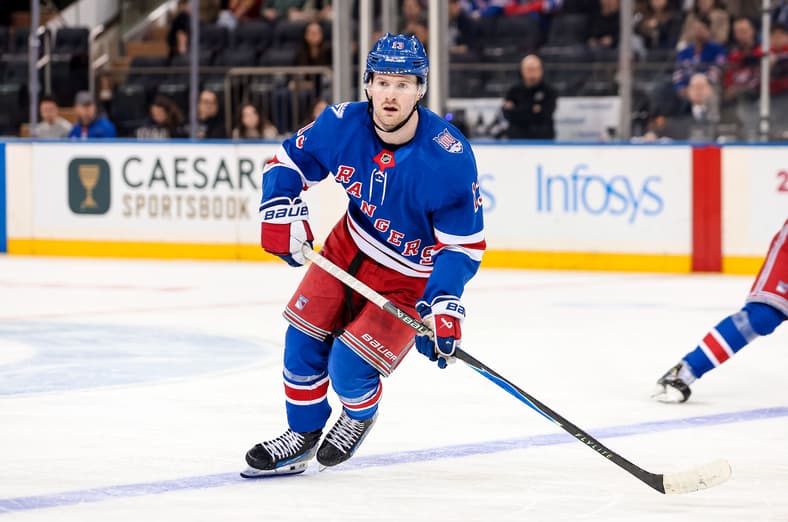
J.T. Miller and Alexis Lafreniere both landed much closer to fair value than the overpaid category. In fact, the difference between Miller’s $8 million cap hit and his $7.2 million Power Score was just $800,000.
Considering the season Miller had, that result is… debatable. The Rangers captain battled injuries throughout the year and finished with 17 goals and 53 points in 68 games, his lowest full-season production since 2018-19. He also finished with a team-worst minus-30 rating, and the Rangers missed the Stanley Cup Playoffs for a second consecutive season.
There were stretches throughout the season when Miller looked completely disconnected from the game, giving up on plays and losing coverage in the defensive zone. His postgame media availabilities became a storyline of their own, with Miller often struggling to explain what was going wrong as the Rangers’ seasons spiraled out of control. Simply, his emotions often got the best of him.
At the same time, though, Miller still provided value in multiple areas of the ice. He won 61.5 percent of his face-offs and brought physicality, landing fourth on the team with 123 hits. He also averaged more than 20 minutes of ice time per game, playing in every important situation.
Lafreniere’s placement is even closer, with the model valuing his season at $7.2 million compared to his $7.45 million cap hit. The former first overall pick tied his career high with 57 points and was one of the Rangers most productive players after Artemi Panarin was traded, recording 28 points in his final 27 games.
However, much of that production came during the second half of the season. Through his first 56 games, Lafreniere managed just 30 points and struggled to produce at the level expected after signing a long-term extension. His first-half performance likely prevented him from landing in the fair value or underpaid categories despite the strong finish.
Underpaid
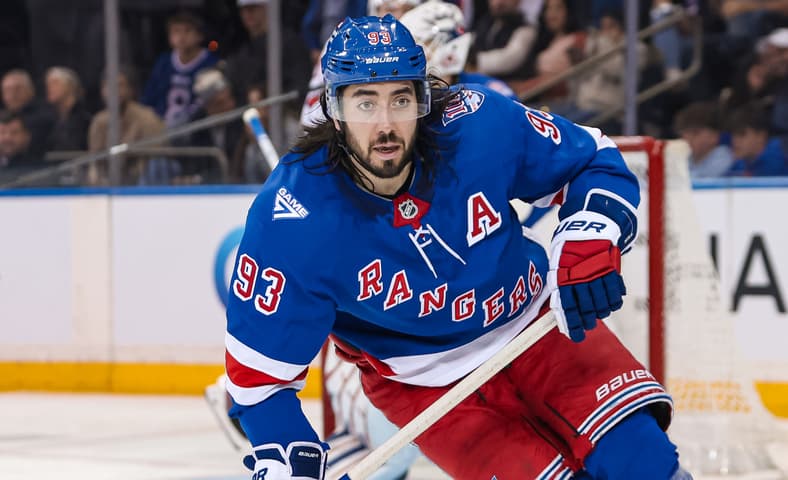
Several Rangers landed in the underpaid category, and though some were expected, others may come as a surprise to fans who spent much of the season criticizing their performance or contract.
For years, Mika Zibanjead’s contract is one of the most heavily scrutinized on the roster. But this past season, Zibanejad reminded everyone why he earned that contract in the first place.
After a severely disappointing 2024-25 season, Zibanejad bounced back in nearly every way. He led all Rangers skaters with 34 goals and 78 points, earned team MVP honors, and was one of the few Rangers who consistently produced offense on a team that struggled to score. More importantly, Zibanejad contributed on the power play, penalty kill, and at even strength. His 16 power-play goals led the team, and he recorded 105 hits after finishing with just 44 the season prior.
An $8.5 million cap hit is never going to look cheap, but Benchrates says that Zibanejad provided roughly $11.3 million worth of value during the 2025-26 season.
Tye Kartye was an interesting name to land in the underpaid category. Claimed off waivers from the Seattle Kraken, Kartye quickly became a regular in the Rangers lineup and provided an immediate spark.
He recorded 14 points in 24 games on Broadway, added 75 hits, and contributed in a big way on the penalty kill. Kartye’s offensive production may not be sustainable over a full season, but for a player carrying a $1.25 million cap hit, the Rangers received far more than they probably expected when they acquired him. Benchrates valued Kartye’s performance at $3 million annually, making him one of the Rangers’ biggest bargains.
Two other names that stick out in the category are veterans forwards Jonny Brodzinski and Conor Sheary.
Brodzinski recorded 16 points in 55 games while continuing to fill whatever role the Rangers asked of him. Brodzinski never developed into more than a depth forward, but he consistently provided decent minutes at close to the League minimum. Benchrates valued his 2025-26 season at roughly $2.5 million, more than triple his actual cap hit. With Brodzinski set to become an unrestricted free agent and expected to move on from the Rangers, replacing that inexpensive depth won’t be as easy as it seems.
Though there was no lower amount the Rangers could have paid Sheary, many who believe the 33-year-old didn’t provide nearly enough value to justify a lineup spot. After scoring just one goal through his first 43 games and still finding himself in the lineup on a nightly basis (often in the top-six) except when injured, Sheary was a source of frustration for many Rangers fans. With the season slipping away and the Rangers supposedly shifting the focus towards the future, many questioned why an aging player with a single goal continued to receive ice time.
However, as the season progressed, Sheary began to find his game. He scored six goals and had nine points over his final 23 games, finished the season with 18 points, and developed chemistry alongside Miller and Kartye down the stretch. Benchrates valued Sheary’s season contract at roughly $2.8 million despite a cap hit of just $775,000.