Best Rangers options with No. 5 pick at NHL Draft after scouting combine

While most of the hockey world kept its attention locked on the Stanley Cup Final, another key event, one far more important to the New York Rangers, quietly unfolded in Buffalo this past week. The NHL pre‑draft Scouting Combine took place, featuring 90 top prospects cycling through interviews, medical evaluations, and fitness testing split between KeyBank Center and LECOM HarborCenter.
For the Rangers, nothing that emerged from the combine offered any real hint about their intentions. If anything, the chatter around the League only reinforced what most scouts already believe: the top four picks of the 2026 NHL Draft, set for June 26-27 in Buffalo, appear all but set.
- Toronto — Gavin McKenna, LW, Penn State
- San Jose — Chase Reid, RHD, Soo Greyhounds
- Vancouver — Caleb Malhotra, C, Brantford
- Chicago — Ivar Stenberg, RW, Frölunda (Sweden)
If that’s the case, what will the Rangers do with the No. 5 overall pick? Let’s look at their updated options.
Best move for Rangers: Carson Carels
With the Rangers sitting at fifth overall, the board opens up in a way that gives Chris Drury options — real options. Yes, the entire hockey world knows the Rangers desperately need a center and a right‑shot defenseman. But what if the Rangers decide to go with the typical MO of John Lilley, New York’s director of player personnel & amateur scouting, and select the best available player?
If the Rangers decide to go with the best available player, that would be Carson Carels, even though he is a left-handed defenseman. Carels is the best overall defenseman in the draft, a player whose ceiling projects well beyond traditional positional needs. At 6‑foot‑3 with elite mobility and a physical edge to his game, Carels blends shutdown ability with transition play in a way NHL teams covet, and he does it without sacrificing poise or decision‑making.
The 17-year-old also broke out offensively with Prince George in the WHL this season, scoring 20 goals and totaling 73 points in 58 games. Plus, he had 66 penalty minutes. Think: complete package.
Carels is headed to North Dakota next season, a program with a long track record of producing NHL‑ready defensemen. Heck, North Dakota is where defenseman prospect EJ Emery, New York’s 2024 first round pick, plays. Better yet, unlike your typical freshman, Carels’ game already fits their mold: calm under pressure. Plus, he fits what Mike Sullivan said on breakup day, that the Rangers need another defenseman not named Adam Fox who can move the puck up the ice with either his skating or first pass.
For the Rangers, the argument is simple: if you believe Carels is a future top‑pair defenseman, you don’t pass on that at fifth overall just because he shoots left. Elite defensemen tilt the ice regardless of handedness, and the Rangers’ pipeline doesn’t currently feature a prospect with Carels’ combination of size, skating, and projection. If the forwards they want are gone and the right‑shot defensemen don’t justify the pick, Carels becomes the best‑player‑available swing — the kind of selection that pays off for a decade.
And think about a left side that already features Vladislav Gavrikov and Drew Fortescue. The Rangers re-sign Matthew Robertson for one to two years, which buys time for Carels to develop. And they still have the 26th pick to use on a right-handed defender or center.
Making the case for Keaton Verhoeff
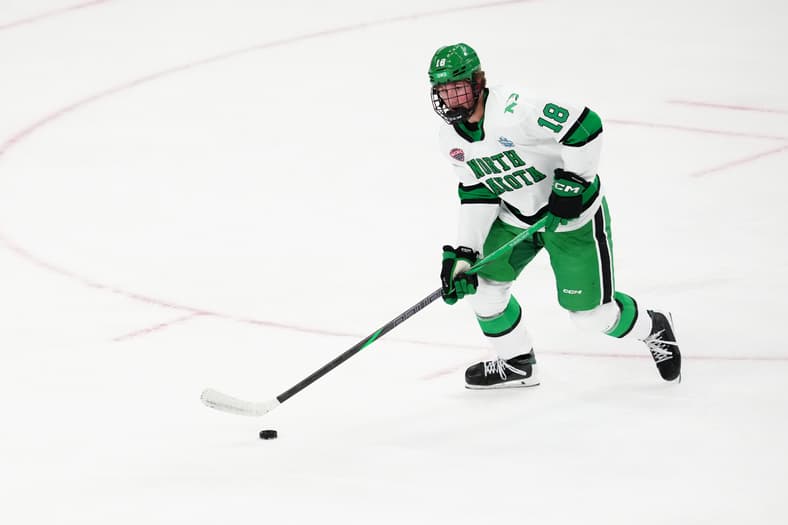
If the Rangers want to stay true to positional need without forcing the pick, right-shot defenseman Keaton Verhoeff is the cleanest fit on the board. At 6‑foot‑4 and already playing a mature, pro‑style defensive game, Verhoeff brings the kind of calm, mistake‑free presence that NHL coaches trust immediately. He doesn’t have Reid’s dynamic ceiling, but he might have the higher floor — and for a team that struggled to stabilize its right side behind Fox, that matters.
Verhoeff’s game is built on composure. He handles pressure well, kills plays early, and rarely gets caught chasing. His reads are advanced for his age, and he has the skating base to keep up with NHL pace. Offensively, he may never run a power play, but he moves the puck efficiently and doesn’t stall transitions. In other words: he’s the kind of defenseman who makes everyone around him better. This past season, he had 20 points (six goals, 14 assists) in 36 games as a North Dakota freshman.
For the Rangers, Verhoeff represents the safest version of “need meets value.” If they believe he can anchor a second defense pair for a decade — and many scouts do — then taking him at fifth overall isn’t a reach.
Making the case for Daxon Rudolph
But if the Rangers want upside — real, game‑breaking upside — then right-shot defenseman Daxon Rudolph is the swing worth taking.
Rudolph is the kind of player who jumps off the screen. His skating is explosive, his edges are elite, and he plays with a confidence and creativity that you simply can’t teach. He attacks open ice, drives play with pace, and has the offensive instincts of a modern puck‑moving defenseman who can tilt the rink by himself. When he’s on, he looks like a player who could eventually run an NHL power play.
With a cannon of a shot, Rudolph scored 28 goals and totaled 78 points in 68 games for Prince Albert. He also tied for WHL postseason lead with 27 points and 18 assists.
What makes Rudolph especially intriguing for the Rangers is how his strengths align with where the League is going. Transition defense, retrievals under pressure, controlled exits — these are the areas where he thrives. He’s not just fast; he plays fast. And though still refining his defensive reads, Rudolph’s tools are so high‑end that you bet on the development curve.
If the Rangers believe they need a potential star on the back end — not just a stabilizer — Rudolph is the pick. He’s the kind of player who could reshape the identity of their defense in three years, not six. And at fifth overall, that kind of ceiling is hard to ignore.
Why Rangers might pass on both — Enter Alberts Smits
There’s also a very real scenario where the Rangers look at both Verhoeff and Rudolph — two talented but very different right‑shot defensemen — and still decide neither is the right fit at No. 5. Verhoeff offers stability but not star potential. Rudolph offers upside but comes with risk and a longer development curve. If the Rangers front office feels that neither player cleanly matches the value of a top‑five pick, the door opens for a different kind of swing.
That’s where Alberts Smits enters the conversation.
Smits is one of the most intriguing wild cards in the draft: a big (6-foot-3), rangy left-shot defenseman who represented Latvia as an 18-year-old at the Milan-Cortina Olympics, and contributed two assists in four games. He also was a top-pair defenseman for his country at the 2026 World Junior Championships, and averaged a point per game there (five points; one goal, four assists in five games).
What makes Smits especially compelling is his trajectory. His game has taken major steps forward over the past year, and scouts believe he’s only scratching the surface of what he can become. He played in Liga l;ast season and had 13 points (six goals, seven assists) in 38 games, and then appeared in five games in the DEL, in Germany.
Passing on positional need is never easy, but if the Rangers believe Smits has the highest ceiling of the three — and that his development arc is pointing sharply upward — then selecting him at fifth overall becomes a legitimate, defensible choice. Sometimes the best move is to take the player who might become special, not the one who simply fills a hole.
Conclusion: Rangers No. 5 Pick may come down to who falls
The beauty — and the chaos — of drafting fifth overall is that the Rangers don’t control what happens in front of them. They can prepare for every scenario, build out every board, and run every possible scenario, but the truth is simple: their decision may ultimately be made for them.
If the draft unfolds as expected, the Rangers will likely be choosing between the top defenseman available or the highest‑ceiling blueliner who fits their long‑term vision. Carson Carels, Daxon Rudolph, Keaton Verhoeff, and ALberts Smits each offers a different path, and each would address a real organizational need in a different way.
But the wild card — the scenario every team quietly hopes for — is the forward who unexpectedly slips.
Every draft has one. A top‑six talent who was penciled into the top four suddenly becomes available at five because a team ahead reached for positional need or fell in love with a defenseman. Or someone wants one of these defensemen bad enough that they trade over the Rangers for one.
If that happens this year, the Rangers’ choice becomes much simpler. If any of the top three forwards fall down to five then the Rangers take him. It is not something one overthinks. You don’t force a defenseman because it fits the depth chart. You take the forward with the highest upside and go from there.
Whether it’s a center with top‑line projection or a winger with game‑breaking skill, a falling forward changes the entire equation. And for a team that still needs long‑term scoring depth behind its current core, that kind of gift can reshape the franchise just as much as a top defenseman.
So as the Rangers step to the podium on draft night, the question won’t just be who they want. It will be who’s still there. And sometimes, that makes all the difference.