Rangers’ biggest hits and misses in free agency, from Panarin to Redden

The New York Rangers have had some big hits in free agency from the 1970s to the present day – most notably forward Artemi Panarin, who makes his return to Madison Square Garden on Monday night with the Los Angeles Kings after being traded on Feb. 4.
Of course, there have been some real bombs as well.
Some of the hits have been of the big-ticket variety — like Panarin — the kind of player everyone knows about. Others have been solid players who stepped up their games when they arrived on Broadway, while still others came from out of nowhere and turned into valuable contributors.
And the misses? They’ve ranged from players who played OK hockey for big money to others who were total failures and left the Blueshirt Faithful wondering why management signed them in the first place.
Here’s a look at the five best and five worst free-agent signings in Rangers history:
The Best
5. Two Sweet Swedes
The Signings: Rangers signed center Ulf Nilsson and forward Anders Hedberg to two-year contracts
Date: March 20, 1978
Why it mattered: Free agency within the NHL was unheard of 1978, but raiding the rival World Hockey Association was perfectly OK. GM John Ferguson did just that in March 1978 when he announced that two of the WHA’s biggest stars, Swedish linemates Ulf Nilsson and Anders Hedberg, would be heading to the Big Apple for the 1978-79 season.
The two, along with left wing Bobby Hull, had terrorized WHA goalies for years with the Winnipeg Jets, so the news of the Swedes’ impending arrival left Rangers fans salivating. Hedberg scored at least 50 goals and finished with 100 points in each of his four WHA seasons. Nilsson averaged 121 points in his four WHA seasons and never had fewer than 76 assists.
Neither came close to those totals in the NHL, but both were fine players who keyed the Rangers’ run to the 1979 Stanley Cup Final.
Hedberg had three straight 30-goal seasons and led the Rangers in scoring in 1978-79. A knee injury limited him to four games in 1981-82, but he had at least 20 goals in each of his six seasons before retiring in 1985.
Nilsson was averaging well over a point a game in his first season before he sustained a broken ankle caused when he caught a rut in the ice at the Garden as he was hit by Islanders defenseman Denis Potvin (unlike Rangers fans, he absolved Potvin of any blame). Nilsson also missed the entire 1981-82 season because of a knee injury sustained playing for Sweden in the 1981 Canada Cup. He played just 10 games in 1982-83 before retiring with 169 points in 170 NHL games.
4. Trocheck is a Hit on Broadway
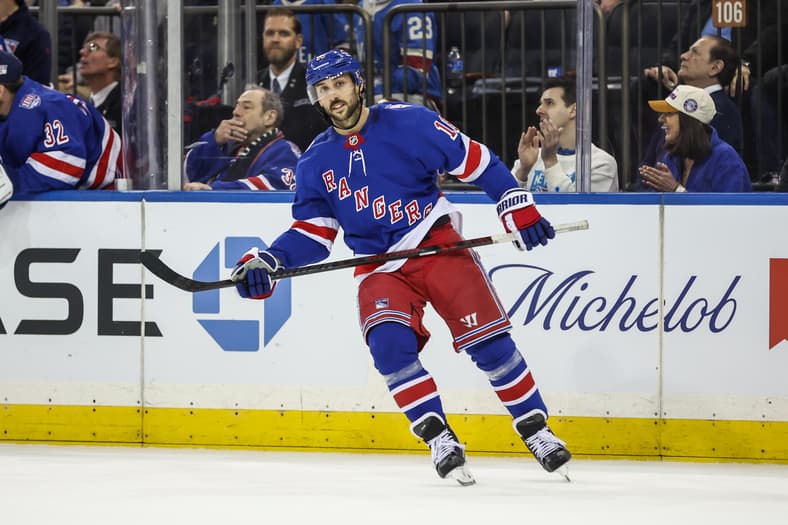
The Signing: Rangers signed center Vincent Trocheck to a seven-year contract
Date: July 13, 2022
It’s easy to find fault with a lot of general manager Chris Drury’s moves, so give him credit for one that worked out big time.
Vincent Trocheck was a solid middle-six center with the Florida Panthers and Carolina before Drury brought him to New York in the summer of 2022. He said he made the decision to join the Rangers because he didn’t want to come to a team that didn’t have a chance to win every year.
The Pittsburgh native was a big reason the Rangers got to the Eastern Conference Final for the second time in three seasons in 2023-24. Not only did he finish with a career-high 77 points and earn a spot in the NHL All-Star Game, he also led the Rangers in the postseason with 20 points in 16 games, scored his first career playoff overtime goal (a double-OT winner against Carolina) and set up two other OT tallies.
He hasn’t matched those numbers since but remains one of the NHL’s best two-way centers – productive offensively, a star in the face-off circle, an ace penalty-killer and a leader in the locker room. He showed his multi-faceted skills while helping Team USA win gold at the 2026 Milan-Cortina Winter Olympics. Trocheck’s average cap hit of $5.625 million on a contract that runs through 2028-29 has been an incredible bargain.
3. A “Great” Day for the Rangers
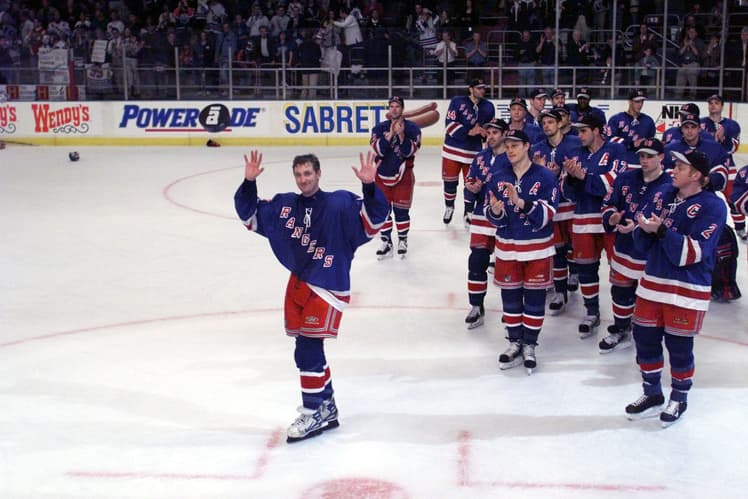
The Signing: Rangers sign center Wayne Gretzky to a two-year contract
Date: July 21, 1996
The Rangers knew they weren’t getting the 1980s version of Wayne Gretzky when they signed “The Great One” in the summer of 1996. But even a 35-year-old Gretzky was still a force to be reckoned with, especially because he was rejoining his longtime Edmonton Oilers teammate Mark Messier.
The Gretzky-Messier tandem carried the Rangers to the Eastern Conference Final in 1996-97, which turned out to be their only season together in New York. No. 99 was No. 1 in the NHL with 72 assists, led the Rangers with 97 points, was voted a Second-Team All-Star and had 20 playoff points (including a first-round hat trick against the Florida Panthers) before the Philadelphia Flyers bounced them in five games.
Gretzky led the NHL in assists again in 1997-98 with 67 and repeated as a Second-Team All-Star. But with Messier gone after signing with the Vancouver Canucks as a free agent, they finished 15 points out of a playoff berth. The Blueshirts were out of the playoff race for most of 1998-99, and as the end of the season neared, Gretzky decided it was time to call it a career. On April 16, two days before the end of the season, he announced he would retire after the Rangers’ season finale against the Pittsburgh Penguins at Madison Square Garden.
Appropriately, his last NHL point was an assist — one that came on the Rangers’ lone goal in a 2-1 overtime loss. After the teams left the ice, Gretzky came back out for a solo skate. “I made a lot of curtain calls, but the fans wouldn’t stop cheering,” he said. “I cried; I broke down a couple of times.”
The Great One never did win the championship he’d hoped for in New York, but he did put up 57 goals and 249 points in his 234 games as a Ranger.
2. Riding the “Gravy” Train
The Signing: Rangers sign forward Adam Graves to a five-year contract
Date: Sept. 3, 1991
Before joining the Rangers as GM in 1989, Neil Smith had worked for the Detroit Red Wings. One of the players he scouted was Adam Graves, who was selected by Detroit in the second round of the 1986 NHL Draft. But the Wings traded Graves to Edmonton in November 1989, and he was part of the Oilers’ championship team the following spring.
However, Smith never forgot Graves, and when he became a Group I free agent after the 1990-91 season, the Rangers signed him to a five-year contract, giving up forward Troy Mallette as compensation. Graves was originally given No. 11; however, he quickly shifted to No. 9 after the Rangers acquired former Edmonton teammate Messier a month later.
Coach Roger Neilson put Graves on Messier’s left wing, and he began filling the net. After seasons of 26 and 36 goals, “Gravy” broke the Rangers’ single-season goal-scoring record with 52, then piled up 10 more in the playoffs; the last one came in Game 7 of the Final and helped the Rangers end their 54-year championship drought.
Graves’ style of play was simple but effective — get to the front of the net and make life miserable for opposing goalies. Most of the 280 goals he scored in 10 seasons on Broadway didn’t travel very far. But he might have been even more valuable for what he did for the team and the community. Though he was tough as nails on the ice, scoring goals and protecting teammates so well that the Rangers retired his No. 9 on Feb. 3, 2021, away from the rink, he was humble, caring and kind — and still is.
1. The Breadman Delivers
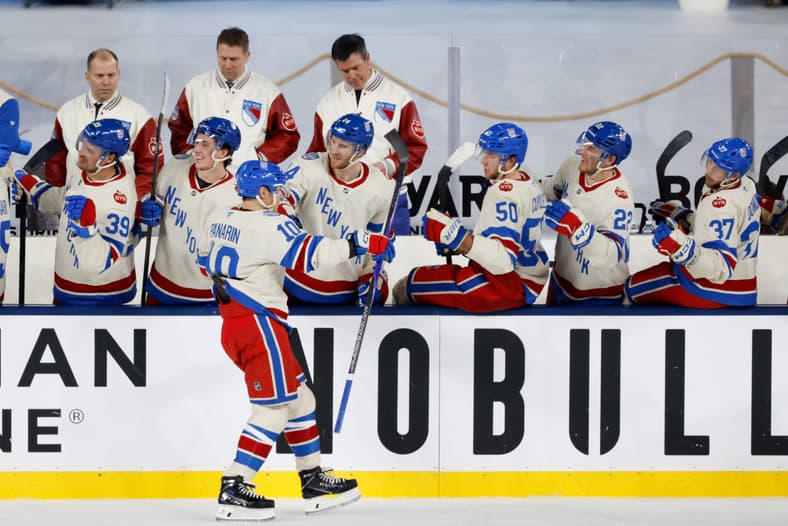
The Signing: Rangers sign forward Artemi Panarin to a seven-year contract
Date: July 1, 2019
Artemi Panarin is without a doubt the best free-agent signing in Rangers history. It’s not even close. Trading him to the Kings marked the end of an era.
The Breadman had plenty of suitors when he became an unrestricted free agent in the summer of 2019. But he reportedly turned down more money from at least one other team to sign a seven-year, $81.5 million contract with the rebuilding Rangers. Talk about money well spent!
Panarin’s arrival jump-started the rebuild the Rangers announced before the 2018 NHL Trade Deadline and was a major factor in their trips to the Eastern Conference Final in 2022 and 2024. He had career highs of 49 goals and 120 points in 2023-24, helping the Rangers win the Presidents’ Trophy as regular-season champs; the 120 points are the second-highest single-season total in Rangers history, trailing only Jaromir Jagr’s 123 in 2005-06.
He is the only player in team history to break the 90-point mark four times (he missed by one point last season), and he’s one of just five Rangers to score as many as 49 goals in a season. Panarin’s 1.26 points per game is the most in the Rangers’ 100-year history; he reached 400 points faster than anyone in team history, and his 607 points (205 goals, 402 assists) are the most by any Ranger who played fewer than 500 games (he played 482).
Few free-agent signings in NHL history have paid off like this one.
The Worst
5. Striking out on Richards
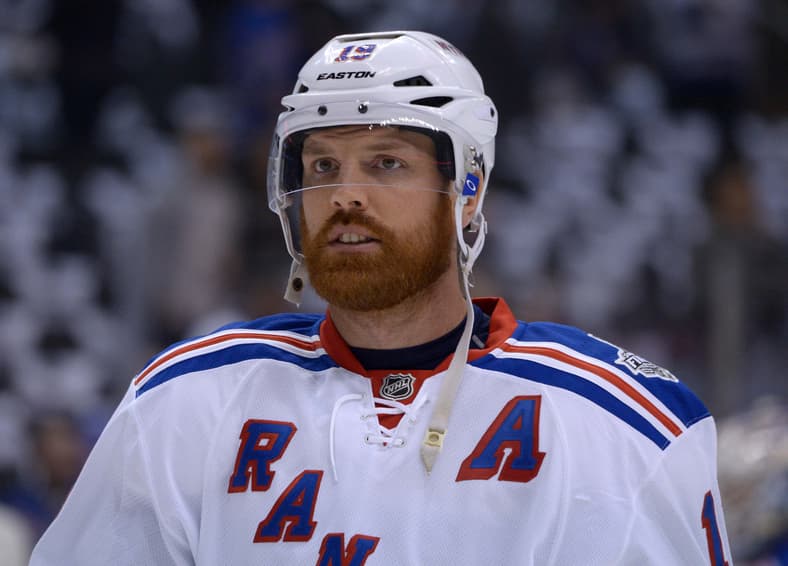
The Signing: Rangers signed center Brad Richards to a nine-year contract
Date: July 1, 2011
The Rangers have never been reluctant to open their wallet for free agents. Brad Richards, the biggest fish in the 2011 free agent pool, won the Conn Smythe Trophy as playoff MVP in 2004, when John Tortorella led the Tampa Bay Lightning to the Stanley Cup. With Tortorella now behind the bench with the Rangers, it was no surprise that the 31-year-old center wound up signing mega-deal to come to New York.
Richards was coming off seasons of 91 and 77 points with the Dallas Stars. He had lost a step and didn’t come close to those numbers in New York, but his 66 points in 2011-12 helped the Rangers finish first in the Eastern Conference, and he was a 20-goal scorer two years later when the Rangers got to the Stanley Cup Final for the first time since winning it in 1994.
But the collective bargaining agreement that ended the 2012 lockout turned Richards’ contract into an enormous liability. The deal had been structured so that he wouldn’t play the last three seasons (but would earn $1 million per season). However, such contracts were considered cap circumvention under the new CBA, meaning that if he retired early, the Rangers would be on the hook for more than $5 million for each of those three seasons — for a player no longer on the roster. They wound up buying out the final six seasons of the contract, meaning that Richards ended up getting paid about $53 million for his three seasons in New York.
He signed with the Chicago Blackhawks and almost wound up facing his old team in the 2015 Final, but the Lightning knocked off the Rangers in Game 7 to win the Eastern Conference Final before losing to the Hawks in six games.
4. Kaspar the Unfriendly Ghost
The Signing: Rangers sign defenseman Darius Kasparaitis to a six-year contract
Date: July 2, 2002
The Rangers wanted a more physical presence on the blue line after missing the playoffs for five consecutive seasons. To get one, they outbid the Toronto Maple Leafs for Darius Kasparaitis, signing him to a six-year deal worth an average of $4.25 million even though he’d never scored more than four goals or finished with more than 21 points in a season — and having been hampered by a couple of major injuries.
Ironically, one of the callers in the recruiting drive for “Kaspar” was Rangers center Eric Lindros, who had missed a month after being knocked unconscious by a Kasparaitis check four years earlier during his time with the Philadelphia Flyers.
The Rangers paid Kasparaitis to be what he was at his best — a human wrecking ball who had no compunctions about leveling the NHL’s top players (he was famous for flattening both Wayne Gretzky and Mario Lemieux) with the kind of hip check that was rarely seen anymore.
He did just that in his first season with a rebuilding team, banging bodies and forcing opponents to keep an eye out for them. But his hitting ability was often negated by his lack of speed and offensive skills. His playing style also led to more injuries, which slowed him even more.
The Rangers waived Kasparaitis prior to 2006-07; he went unclaimed and became a very expensive AHL defenseman for the final two seasons of his contract.
3. Devil Disasters
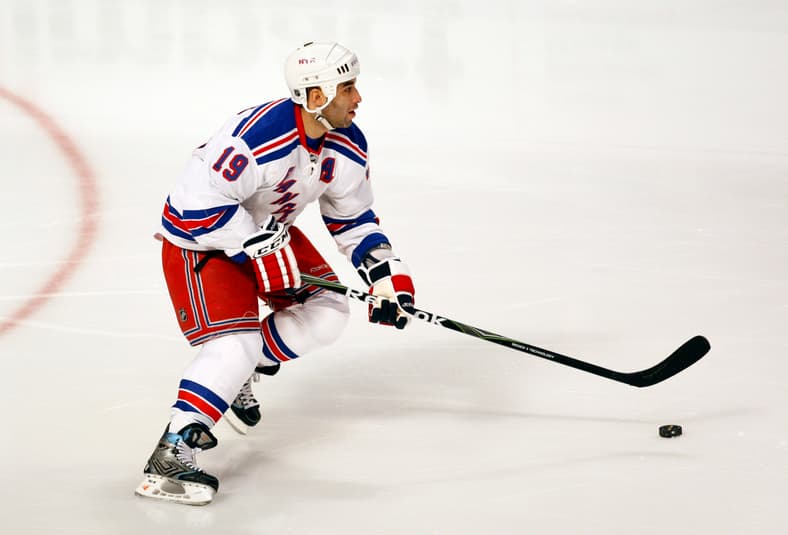
The Signing: Rangers signed center Bobby Holik to a five-year contract
Date: July 1, 2002
The Signing: Rangers signed center Scott Gomez to a seven-year contract
Date: July 1, 2007
The Rangers went 0-for-2 on their signings from their cross-river rivals in the early 2000s.
Bobby Holik, who centered the “Crash Line” that helped the Devils win the Stanley Cup in 1995 and 2000, crashed and burned when he took his game across the Hudson River. The big, physical center put up very good offensive numbers for someone who spent most of his time on a checking line. — he averaged 23 goals and 57 points from 1996-97 through 2001-02. With the Rangers’ non-playoff streak at five seasons and counting, GM Glen Sather threw money at Holik, signing him to a five-year deal worth $45 million. That’s $9 million per season for a 31-year-old who wasn’t a first-line player.
But with a big contract came big expectations — ones that Holik couldn’t meet. His offensive numbers fell sharply in 2002-03. They rebounded in his second season, but 25 goals and 56 points weren’t nearly enough to prevent the Rangers from missing the playoffs for a seventh straight season.
The Rangers wasted little time buying out the final two seasons of his contract after play resumed following the 2004-05 lockout. Holik spent the next three seasons with the Atlanta Thrashers before ending his career with New Jersey. He finished his career with 326 goals and 747 points in 1,314 games as well as two Stanley Cup rings — and a boatload of money from one of the worst contracts in Rangers history.
The Blueshirts landed Scott Gomez, a 28-year-old two-time Stanley Cup winner with the Devils, in the summer of 2007. The thought at the time was that they were getting one of the NHL’s best centers and weakening a division rival at the same time. The reality was a lot different.
Part of the problem was the expectations that went along with a contract worth $7.5 million annually. Gomez had just one 20-goal season in New Jersey but was expected to put the puck in the net more often in his new home. But it didn’t happen. He matched his career high with 70 points in his first season at the Garden but scored just 16 goals. He equaled that goal total in 2008-09 but saw his assists (42) and points (58) fall off despite seeing his ice time bumped up to more than 21 minutes a game.
By now, Garden fans were bemoaning spending top dollar on a playmaking center who was over 30 and likely entering the back nine of his career — with a commitment of $35 million still on the books.
The only thing that saved Sather was that he was able to foist Gomez on another team. The Montreal Canadiens took Gomez off his hands in what looked like a salary dump. But part of the return was a college defenseman named Ryan McDonagh – who turned into a stud.
2. Fleury’s Flame-out
The Signing: Rangers signed forward Theo Fleury to a three-year contract (plus team option for a fourth season)
Date: July 8, 1999
After the Rangers missed the Stanley Cup Playoffs in consecutive seasons for the first time in two decades, ownership gave GM Smith access to the checkbook and told him to go shopping.
Theo Fleury had helped the Calgary Flames win the Stanley Cup as a rookie in 1989, then spent the next 10 seasons piling up goals and points. He was coming off his fourth 40-goal season in the summer of 1999; the last 10 came with the Colorado Avalanche after a late-season trade. That was more than enough for Smith and Garden president Dave Checketts to pursue Fleury and get his signature on a contract worth $7 million annually.
But the personal issues that Fleury, who described himself as “a prairie kid from a town of 1,500,” had handled successfully in Calgary weren’t as easily dealt with under the bright lights of Broadway. He struggled on the ice in his first season but found his game in year two and was among the NHL leaders in goals and points until his season ended when he checked into a substance abuse program.
His third season saw him produce 24 goals and 63 points but pile up 216 penalty minutes amid incidents that included a fight with the San Jose Sharks mascot and leaving the arena instead of going to the penalty box. The Rangers didn’t exercise their option and gave him away that summer to San Jose; he wound up signing with the Chicago Blackhawks but another substance abuse suspension ended his NHL career.
Fleury’s autobiography, released in 2009, explained a lot. He recounted how he grew up poor in Manitoba, was sexually abused by junior hockey coach Graham James, drank and gambled excessively, and used cocaine during his career — including his time with the Rangers (happily, he got sober in 2005).
1. The AHL’s Richest Player
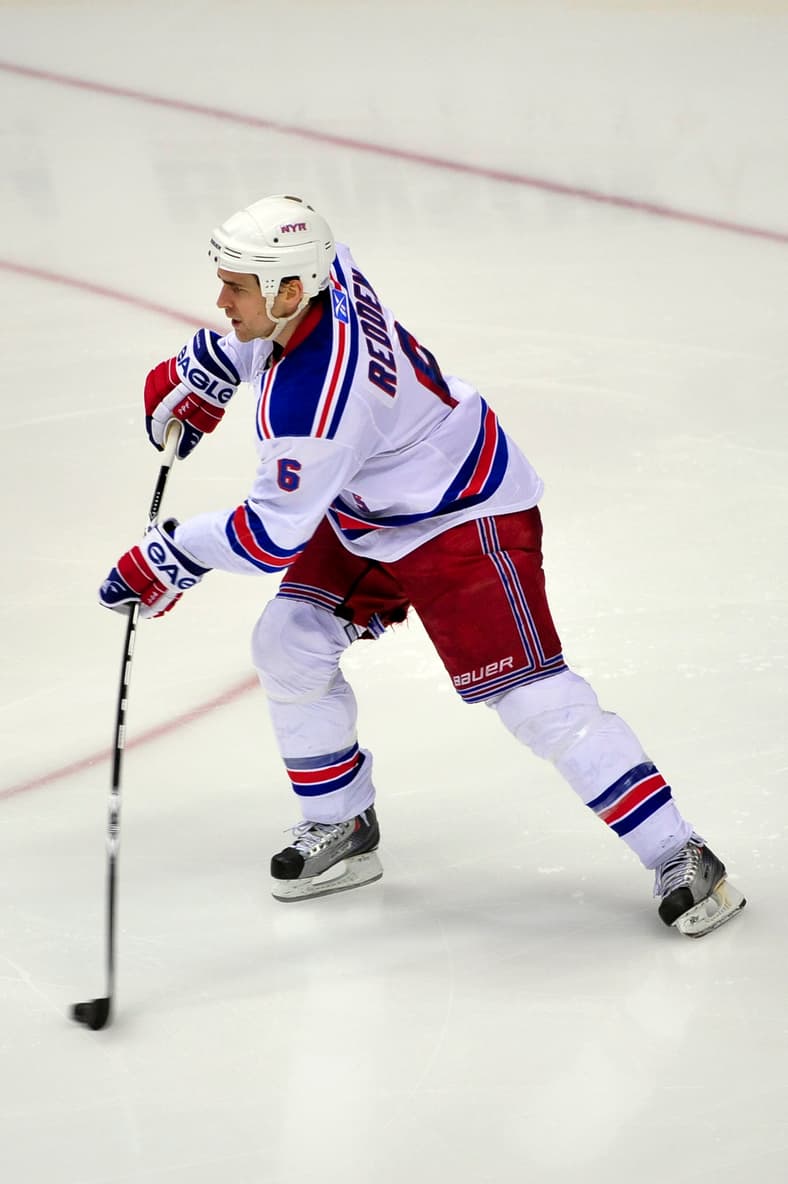
The Signing: Rangers signed defenseman Wade Redden to a six-year contract
Date: July 1, 2008
The Rangers wasted no time signing Wade Redden, a reliable top-four defenseman with the Ottawa Senators for more than a decade, when he became a free agent in the summer of 2008. The 31-year-old had never been spectacular, but he’d reached double figures in goals five times and was a plus player in each of his last seven seasons with the Sens.
Six years and a $6.5 million average annual value were regarded by many as a bit on the high side, though not necessarily outrageous. But given the way things turned out, “outrageous” would have been a major improvement.
Redden had a poor season in 2008-09 and was even worse the following season, managing two goals and 14 points in 75 games. With cap space tight and Redden not producing, the decision was made to waive Redden and send his huge contract to the AHL.
For the next two seasons, he was the AHL’s highest-paid player. He might have stayed there for the remainder of his contract, but the collective bargaining agreement that ended the 2012-13 lockout eliminated most of the benefits of burying a contract in the minors. Instead, the Rangers bought out the final two seasons.
The St. Louis Blues quickly signed Redden, then flipped him to the Bruins at the trade deadline. He retired after playing five games during Boston’s run to the 2013 Stanley Cup Final.
Redden’s signing is still the worst in Rangers history – and a contender for the worst deal by any NHL team.