Why Rangers have salary comp framework for next Braden Schneider contract

If the New York Rangers decide to re-sign Braden Schneider and not trade the 24-year-old defenseman as part of their retool this summer, then they may have a recent salary comparison to help create the framework of a deal.
Though not a perfect apples to apples comparison, there are enough similarities between the Rangers defenseman and Timothy Liljegren to make some arguments for what Schneider’s next deal could, and should, look like.
Liljegren signed a a two-year, $6.5 million contract with the Washington Capitals on Wednesday. He just turned 27 on April 30, and could’ve been an unrestricted free agent July 1.
Schneider can be a restricted free agent with arbitration rights this summer, so he’s basically a couple years younger and one contract behind Liljegren. Two years ago, in the same situation as Schneider is now, coming off his first bridge contract and holding arbitration rights, Liljegren signed a two-year, $6 million contract with the Toronto Maple Leafs.
If the Rangers do another bridge deal with Schneider, he should receive more than Liljegren’s $3 million average annual value from his second bridge contract, perhaps between $3.5-$4.0 million. That’s because — it says here — Schneider is the better defenseman, plus his first bridge deal averaged $2.2 million, while Liljegren’s had a $1.4 million AAV over two years. So, he’s already ahead of the game.
Rangers can use recent NHL signing as comp in Braden Schneider negotiations
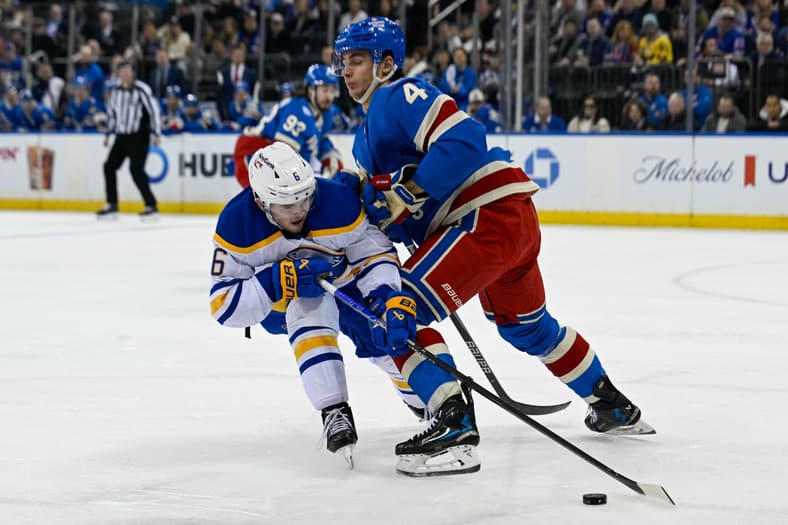
As for the similarities and comps between the two, let’s start that each is a right-shot defenseman and former first-round draft pick — Liljegren No. 17 overall by the Maple Leafs in 2027; Schneider No. 19 overall by the Rangers in 2020. Neither has completely lived up to high expectations yet, with Liljegren now on his third NHL team, and Schneider the subject of trade rumors in recent years, including this one.
Though Liljegren made his NHL debut two seasons before Schneider, he’s played fewer games in the League and is less experienced in the postseason than Schneider, a staple on the Rangers blue line since the 2021-22 season. Schneider’s been a part of two runs to the Eastern Conference Final (2022, 2024) and has 43 Stanley Cup Playoff games under his belt, along with 368 regular-season games. Liljegren played 311 NHL games so far, and another 13 in the postseason.
Schneider is extremely durable, playing at least 80 games in each of his four full NHL seasons, including all 82 twice. Liljegren played 60+ games three times in his career, topping out with 68 in 2024-25, largely due to injury and inconsistent play.
Each blocks a lot of shots, though Schneider is the more physical defender. Liljegren provides a bit more steady production offensively.
Advanced metrics have largely favored Liljegren over Schneider, though neither flourished when given the chance at a more expanded role. That includes this past season when Schneider’s ice-time jumped to a career high 20:27 per game, but his overall game didn’t take off with added responsibility. He disappointed in nearly 30 games on the top defense pair when Adam Fox was injured, and the Rangers cratered, finishing last in the Eastern Conference.
However, after Fox returned and Schneider shifted back to his usual role on the third defense pair, he received praise from coach Mike Sullivan who stated Schneider played “extremely well” down the stretch of the season.
So, all that’s to say, it’s fair for the Rangers to use Liljegren as part of a comp framework for Schneider’s next deal. But it’s not a perfect comparison either.