What Rangers Missing Out on by Not Getting to Draft Gavin McKenna

The New York Rangers still have the opportunity to add a high end prospect with the No. 5 pick in the 2026 NHL Draft. But after a season that saw them finish with the third-worst record in the NHL (34-39-9), few players could have changed the trajectory of the franchise quite like Gavin McKenna.
Alas, not only did the Rangers not win the 2026 NHL Draft Lottery, they dropped two spots from third overall to No. 5. The Toronto Maple Leafs and San Jose Sharks jumped past them. And the Maple Leafs reportedly already told McKenna they’re going to take him with the No. 1 pick.
The Penn State freshman entered the season as the consensus favorite to be selected first overall and reaffirmed that perception over the following eight months in Hockey Valley. McKenna became the first player in program history to earn Big Ten Freshman of the Year honors. Plus he helped Canada win bronze at the 2026 World Junior Championship, when he finished second in tournament scoring with 14 points (four goals, 10 assists).
Meanwhile, there’s no shortage of issues facing the Rangers organization after an underwhelming 77-point season; however, many of the franchise’s biggest weaknesses align directly with McKenna’s best assets. From his ability to control the puck and create offense to the way he elevates the players around him, he checks several boxes that New York must desperately fill.
Having watched McKenna throughout his season in Central Pennsylvania, it became apparent why NHL teams view him as a possible franchise cornerstone. His production jumps off the page, but it was his puck skills, hockey IQ, skating ability, and knack for elevating the players around him that made him look different from nearly everyone else on the ice.
A closer look at his game shows why he would’ve been such a valuable addition for a Rangers team searching for answers everywhere.
Driving Offense
McKenna’s ability to drive offense is one of the biggest reasons he is expected to hear his name called first overall come June 26. Throughout his season at Penn State, the puck seemed to follow him. Whether he was carrying through the neutral zone, creating space in the offensive end, or setting up a teammate, offense often ran through McKenna.
What makes him so dangerous is how comfortable he is with the puck on his stick. Defenders knew McKenna was Penn State’s focal point every game, yet separating him from the puck remained a major challenge. His puck control and edge work, along with his creativity, allowed him to consistently create space on the ice — whether that was for himself or teammates.
And that’s something the Rangers struggled mightily to do throughout this past season. According to MoneyPuck.com, at five-one-five, the Blueshirts ranked 22nd in expected goals percentage (48.5 percent), 20th in shot attempt percentage (47.99 percent), and 27th in unblocked shot attempt percentage (47.99 percent). The Rangers weren’t just struggling to finish chances; they were struggling to even create enough of them.
Making Teammates Better
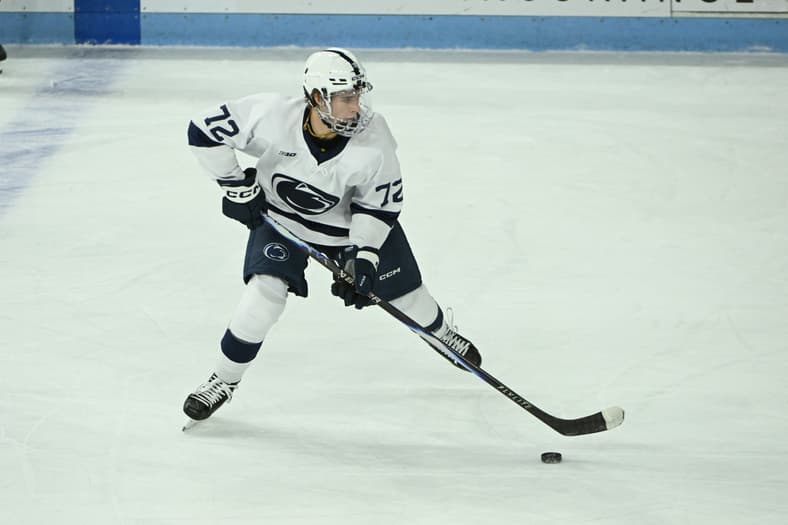
One of the most impressive aspects of McKenna’s game is how he makes his teammates better. Throughout the season, McKenna consistently showed an awareness of where his teammates were on the ice at all times, finding passing lanes and scoring opportunities before they even developed.
McKenna set Penn State’s single-season assists record with 36 and finished third in the Big Ten in scoring with 51 points despite playing fewer games than the two players ahead of him (T.J. Hughes & Michael Hage). His 1.46 points per game ranked ahead of both Hughes (1.43) and Hage (1.33). More importantly, he seemed to know where teammates would be before they got there, putting them in favorable positions to score.
The best example came on Feb. 14 against Ohio State, when McKenna recorded a program-record eight points, including seven assists. Five of those assists were primary, and his seven helpers were the most ever by a Big Ten player and most in an NCAA Division I game since 1983.
The Rangers could have used plenty of that during the 2025-26 season. Time and time again, the Blueshirts’ offense ran dry, particularly at five-on-five, with a scant few forwards driving play. While the Rangers do have some talented forwards, since trading Artemi Panarin they lack players capable of consistently elevating talent on the ice around them.
Speed
One of the Rangers’ biggest issues in recent years is an inability to consistently generate offense off the rush. Many times, we saw players work for every scoring chance in the offensive zone because they lack the ability to create separation through the neutral zone. McKenna does the opposite. His explosive first few strides and elite edge work force defenders to back off, giving time and space before he even reaches the offensive zone.
What makes McKenna particularly dangerous is his ability to turn space into opportunity. Whether carrying the puck through the neutral zone or attacking defenders one-on-one, he consistently finds a way to gain a step on his opponent. Once that happens, he’s extremely difficult to contain.
His skating also complements the rest of his game. The same acceleration that allows him to beat defenders wide, creates additional passing lanes and opportunities for those around him because opponents are forced to respect his speed. Upgrading team speed is a primary focus moving forward for the Rangers, and, for sure, McKenna could’ve helped in that area.
Hockey IQ
As mentioned earlier, McKenna’s vision and ability to create chances for teammates are major reasons he is viewed as one of the best prospects in hockey. However, all of those traits are byproducts of his biggest strength, which is his hockey IQ.
McKenna consistently displayed his ability to process the game at a different level than those around him. Whether it was recognizing where pressure was coming from or anticipating a defender’s next move, he always seemed a step ahead of everyone else on the ice. The impact of his awareness extends far beyond his offensive production, though. It allowed him to extend offensive zone time, avoid some unnecessary turnovers, and dictate the pace of play whenever the puck was on his stick.
The Rangers have frequently struggled with decision-making at key moments, whether it was failed zone entries or forced passes. McKenna’s ability to read and react to the game in real time would’ve provided another high hockey IQ player to join forwards Mika Zibanejad and Gabe Perrault, and defenseman Adam Fox. Each is capable of slowing things down and making the right play in the blink of an eye.
A True Blue-Chip Prospect

The Rangers had highly touted prospects before. Alexis Lafreniere entered the NHL as the consensus No. 1 overall pick in 2020, viewed as one of hockey’s next stars. Other first-rounder picks such as Kappo Kakko, Vitali Kravsov, and Lias Anderson were once considered key building blocks to the organization’s future. Yet for one reason or another, few developed into the franchise-altering players everyone hoped for when they were drafted.
The current prospect pool is in a better spot than it has been in recent years, with Perreault headlining a group that also includes Noah Laba, Adam Sykora, Jaroslav Chmelear, Liam Greentree, and others. But none of those players comes with the type pedigree that follows McKenna into this year’s draft.
Hope
Perhaps the biggest thing the Rangers are missing out on is the excitement that comes with adding a player of McKenna’s caliber to the organization.
The Rangers enter the 2026-27 season searching for answers after finishing with the worst record in the Eastern Conference. Questions surround nearly every aspect of the franchise, from the roster construction to the long-term direction of the team. While the Rangers do have talented players and a few intriguing prospects, there is no clear-cut face of the future.
Just two seasons ago, the Rangers were coming off a Presidents’ Trophy, the best regular season in franchise history, and appeared to be positioned to contend for years to come. Today, that reality is far removed. The Blueshirts missed the playoffs in consecutive seasons and watched much of the core that helped build those successful teams leave.
Chris Kredier is gone, Panarin is gone, Vincent Trocheck seems to be on his way out, and with so much uncertainty surrounding the roster, it’s fair to wonder who else could go. For many fans, it feels like the players and team they grew to love are not so slowly disappearing. McKenna wouldn’t have solved every problem overnight. However, he would’ve given Rangers fans something they haven’t felt in quite some time: a reason to be excited.
But the draft lottery ping pong balls didn’t bounce their way.