How Rangers GM Rewriting Narrative That Began With Pavel Buchnevich Trade

More than five years after the New York Rangers traded Pavel Buchnevich to the St. Louis Blues for Sammy Blais and a second-round pick that was used to draft Adam Sykora, former NHL beat reporter Arthur Staple gave a behind the scenes look at the aftermath of that deal on the Rangers Recon podcast.
Staple talked about Buchnevich’s first game back at Madison Square Garden following the trade and said that Buchnevich wasn’t happy with the “throwaway” welcome back video tribute from the organization.
The longtime hockey journalist further explained that when the Rangers traveled to St. Louis later in the season, he heard Buchnevich was still unhappy with how things were handled following the trade. Despite not being able to talk to Buchnevich directly because he was injured and unavailable to the media, Staple recalled seeing the forward “storming around” the arena looking to confront Rangers general manager Chris Drury.
While the story turned some heads online, Staple’s biggest takeaway came when he reflected on the situation in hindsight, saying, “It was kind of the first indication that things were going to be different under this GM.”
The Buchnevich trade was the first by Drury after he replaced Jeff Gorton as Rangers GM and John Davidson as team president in the 2021 offseason. The deal was widely panned at the time, and in subsequent years, largely because the Rangers never replaced Buchnevich as a top-line right wing — and the fact that “Buch” went on to score 20-plus goals in each of the next five seasons with the Blues.
However, it must be taken into account that Drury traded Buchnevich to free up much-needed salary cap space at the time. But it’s how he mishandled the personal side of things that became a staple — no pun intended — of Drury’s dealings with Rangers players in the coming years that stands out.
Business Over Bonds
In the years that followed, Drury developed a reputation among Rangers players and around the League for prioritizing the business side of hockey over personal relationships. It started to create a pattern; the perception formed that communication between management and players was becoming a growing issue within the Rangers organization. That became a full-blown issue in the 2024 offseason.
Just days before free agency opened up that summer, the Rangers placed Barclay Goodrow on waivers in an effort to create cap space. Though Goodrow was considerably overpaid as a fourth-line former Stanley Cup champion, the move came less than a month after the highly-respected veteran scored six goals and had eight points in 16 playoff games, emerging as one of the Rangers’ most impactful postseason performers during their run to the 2024 Eastern Conference Final.
That the Rangers didn’t inform Goodrow of their decision until moments before placing him on waivers was viewed as a clear sign of disrespect. It angered Goodrow’s now-former teammates on the Rangers.
The San Jose Sharks claimed Goodrow. Afterward, Sharks GM Mike Grier, a good friend of Drury’s, expressed surprise with how things went down.
“I think, from [Goodrow’s] standpoint, he’s probably shocked by how things went down at the end of the day in New York,” Grier said.
Soon after, reports surfaced that the Rangers were exploring trade options involving captain Jacob Trouba, and although those speculations never materialized during the offseason, the public nature of the talks created an uncomfortable situation that lingered into the start of the 2024-25 season — especially when it came out that Trouba used his no-trade clause to block a reported potential deal, specifically for family reasons.

Bad feelings on both sides continued at the start of the season and continued until the Rangers traded Trouba to the Anaheim Ducks on Dec. 8, After the deal, Trouba admitted he wasn’t pleased with how the situation unfolded.
“I’m happy with moving forward, but I’m not overly thrilled with how it went down,” he said. “In my opinion, things could’ve just been handled better. I’m not blaming anybody or anything, just kind of how it happened, I thought it was kind of unfortunate.”
Trouba later said Drury presented him with an ultimatum: Accept a trade, face being scratched from the lineup or be placed on waivers.
“It was a threat,” Trouba said.
Following the Rangers’ disappointing 2024-25 season, several players pointed to the “outside noise” surrounding the team throughout the year. Much of that noise stemmed from the departures of Goodrow and Trouba, along with the public trade speculations involving forward Chris Kreider.
Kreider said the situation became “somewhat of a distraction,” and Mika Zibanejad added that losing two of the team’s leaders (Trouba and Goodrow) “[shook] things around a bit.” Not surprisingly, the on-ice product mirroed the locker-room discord with management.
Rangers coach Peter Laviolette was fired after the season, becoming another casualty of a season that many players believed was tainted by factors that went beyond the ice, and landed at the feet Drury.
Rangers GM Chris Drury Learned From Mistakes
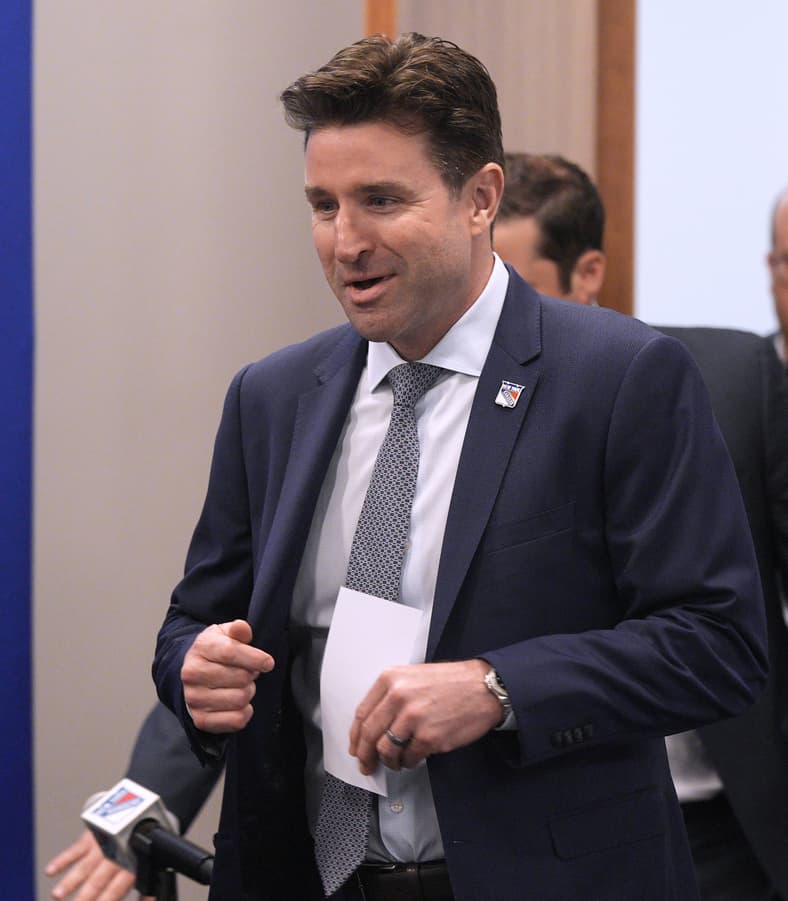
However, there are some recent signs that Drury may be changing his ways.
By the time the Rangers traded Kreider to the Ducks last June, Drury apparently had learned from his prior mistakes in dealing with moving on from key players.
“There was a lot of communication from the Rangers management and from Chris Drury, in particular, about where they stood and kind of what the next steps in the process were going to look like,” Kreider explained. “Around the year-end meetings, we had some good conversations, and I understood that this was a very real possibility.”
Kreider also said he arrived at a feeling of “gratitude” for how he was treated by the organization.
The same message was delivered from K’Andre Miller’s camp, after the Rangers traded the defenseman to the Carolina Hurricanes in July.
Then, following Drury’s letter to fans announcing the organization’s plans to retool the roster, he reportedly met with members of the team’s leadership group, including Artemi Panarin, and informed the best free-agent signing in Rangers history that he would not be receiving a contract extension.
Drury worked through the no-trade clause with both Panarin and his agent on a preferred destination. While moving on from one of the franchise’s best players was a hard decision to swallow, the communication surrounding the situation showed astronomical differences from some of the other departures.
Vincent Trocheck also quickly emerged as one of the veterans most frequently mentioned in trade speculation after the retool announcement, and just like with Panarin, Trocheck told the media he was well aware of the possibility that a move could happen.
He said Drury was “transparent” through the process, and that the Rangers GM was “very open and honest” regarding the organization’s plans and where he stood within them.
So if Staple was right in saying the Buchnevich situation was “the first indication that things were going to be very different under this GM,” the handling of Kreider, Miller, Panarin, and now Trocheck could offer a glimpse into how communication between Rangers management and players is improving and could look moving forward.