Rangers weigh pros, cons of signing free-agent forward Alex Tuch

It’s no secret that the New York Rangers need scoring help after finishing 23rd in the NHL with 235 non-shootout goals this season. They had just one 30-goal scorer (Mika Zibanejad with 34) and two other players who hit the 20-goal mark (Alexis Lafreniere with 24 and Will Cuylle with 20). Zibanejad’s 78 points not only led the team but were 21 more than Lafreniere, the runner-up with 57.
That lack of scoring was a big reason the Rangers missed the Stanley Cup Playoffs for the second straight season and finished last in the Eastern Conference. They were shut out an NHL-leading 10 times, including seven on home ice at Madison Square Garden.
Unfortunately for general manager Chris Drury, there are no superstar offensive talents available when the free-agent market opens on July 1. Drury has about $26.6 million to spend, according to PuckPedia – but there’s no Connor McDavid, Jack Eichel, Kirill Kaprizov, Kyle Connor, Martin Necas nor Adrian Kempe to be had. Each star forward received a long-term contract with an average annual value of at least $10.625 million when they re-upped with their current teams and bypassed free agency.
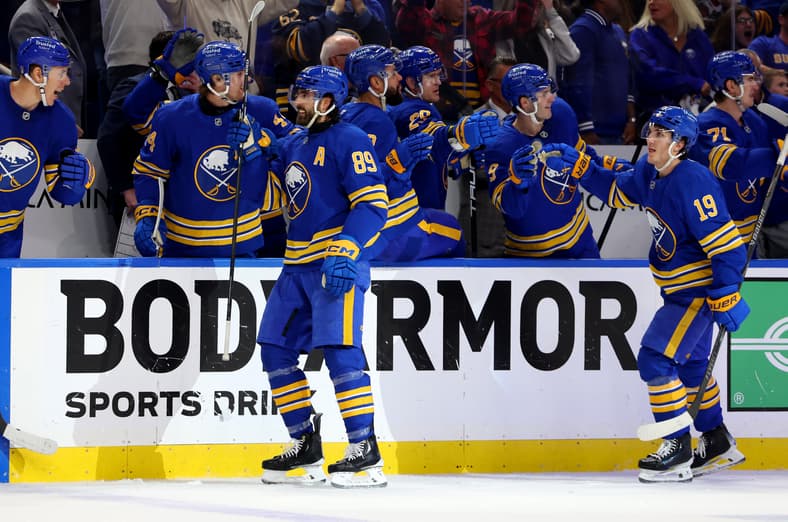
The best unrestricted free-agent scorer who can hit the market is Buffalo Sabres forward Alex Tuch. The 30-year-old helped the Sabres win the Atlantic Division with 33 goals and 33 assists for 66 points. He was second on the Sabres in goals, third in points and fourth in plus-minus (plus-24).
Tuch surpassed the 30-goal mark for the third time in the past four seasons, and his plus-minus number was a career best. He scored four goals and finished with seven points in Buffalo’s six-game win against the Boston Bruins in the first round of the Stanley Cup Playoffs. However, Tuch was pointless in the Sabres’ seven-game loss to the Montreal Canadiens in the second round.
Barring a trade, the Sabres are the only team that can negotiate with Tuch until July 1. That gives Drury plenty of time to decide whether he’ll make a big push for him. It’s a decision that could have a major impact on the Rangers for years to come.
Let’s examine the pros and cons of signing Tuch, from a Rangers perspective.
The case why Rangers should sign Alex Tuch
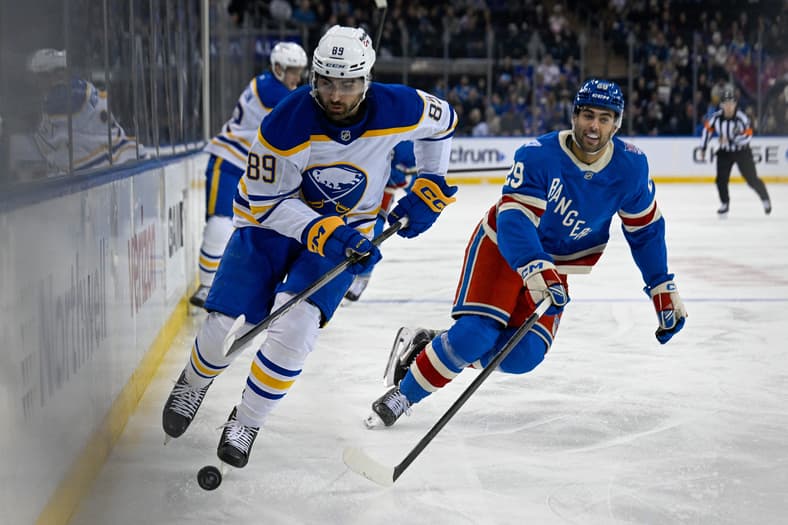
There is no other free agent with offensive numbers close to Tuch’s during the past four seasons. He would provide an immediate boost to the Rangers’ top-six forward group, and likely get more power-play time than he did in Buffalo (1:40 per game, ninth on the team).
Despite the limited man-advantage time, Tuch was third on the Sabres with seven power-play goals; Zibanejad (16) and Lafreniere (9) were the only Rangers who topped that total – and both averaged substantially more power-play time. Zibanejad averaged 3:16; Lafreniere averaged 2:25.
But Tuch can also kill penalties – he averaged 2:26 of short-handed ice time this season and was a big reason the Sabres were fourth in the NHL on the penalty kill at 81.9 percent. He also scored three of Buffalo’s 11 short-handed goals, which were one shy of the League-leading Carolina Hurricanes.
Forwards who can score 30 goals and play on both special teams don’t grow on trees. They’re also not cheap. But money shouldn’t be an issue for the Rangers.
Tuch reportedly wants an eight-figure AAV contract – something the Rangers should be able to accommodate without too much effort. However, the Sabres – who have less than $12 million in cap space — might not want to go there. If Tuch comes to market, the Rangers figure to have interest.
The case why Rangers should pass on signing Alex Tuch

OK, let’s concede that Tuch is a very good player. He fits coach Mike Sullivan’s preferred play style. His power-play numbers would likely go up, he’s an effective penalty-killer and can fill a top-six role on a team that needs offensive help. He is easily the best player who could hit the UFA market.
What Tuch isn’t is elite. He’s an excellent complementary player, one who can play on the first line and be productive – but not the type that you build a team around. So, you spend eight figures annually on such a player? Especially a 30-year-old, when you’re in the middle of a retool?
In his midseason “Letter 2.0,” Drury said the Rangers want to get younger. But Tuch is already 30, and he’d likely want a seven-year contract – meaning the Rangers would carry a huge AAV for a player in his mid- and late 30s. The risk would be sacrificing short-term gain for long-term pain.
And they’d likely have to overpay for Tuch in a watered-down free agent class.
The verdict
The NHL salary cap will be $104 million in 2026-27, $113.5 million in 2027-28 and is projected to keep rising. That, and the lack of good forwards available, should combine to make Tuch the highest-paid player at his position from this free agent class – if (a big if) he doesn’t re-sign with the Sabres before July 1.
If Drury wants to get the Rangers back into the playoffs next season, the easiest path is to go all-in for Tuch – that would mean a max-length contract likely with an AAV of at least $11 million. That’s a huge commitment. But there are no other clear options in free agency who can make the potential impact Tuch can as a scorer for a team that doesn’t have a lot of offense in the product pipeline.
How much that’s worth is the question.
The current Rangers don’t have the firepower to get back into the playoffs. But if Tuch is going to want $10 million-plus on a seven-year contract, Drury should take his checkbook elsewhere. He’s a fine player, but not one worth an eight-figure AAV/seven-year commitment.