Rangers prospects stock report: Who’s trending up, down, including Malcolm Spence

With the New York Rangers season on it’s last legs, it is worth spending time examining how their 13 North American prospects fared in 2025-26.
Included in this group are top NCAA prospects Malcolm Spence and EJ Emery, as well OHL junior standouts like Nathan Aspinall and Liam Greentree.
So, let’s do a stock report, breaking down by draft year which Rangers prospects in North America saw their stock value rise, fall, or remain the same.
2025 Draft Class
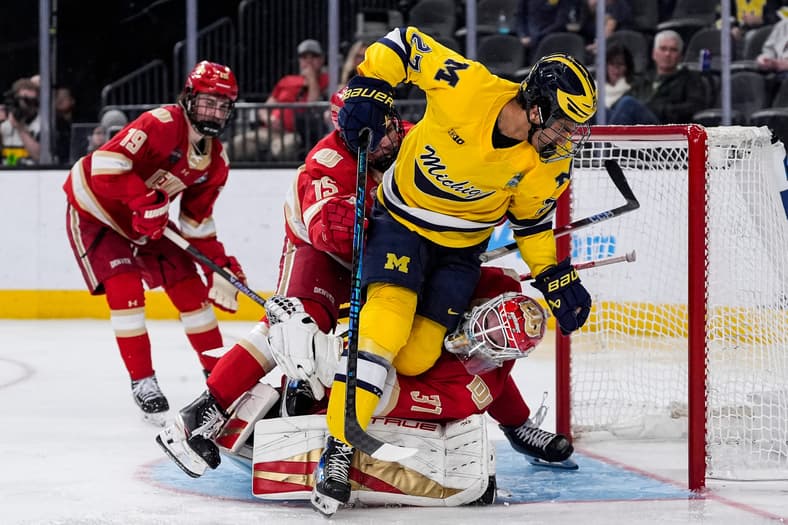
Malcom Spence (second round): Stock Up
Spence didn’t post massive numbers this season as a freshman at Michigan (25 point; 10 goals, 15 assists in 40 games), but his game grew in all the ways coaches value. The 19-year-old forward started on Michigan’s third line and earned his way up to the first by consistently making the small, winning plays — clean exits, smart support, second efforts, and reliable defensive reads. As the season went on, he became a player the staff trusted in tougher minutes, and his role expanded because he drove play even when he wasn’t scoring. It wasn’t a flashy season, but he did score the deciding goal in the Big Ten championship game and played an important role to help get Michigan into the Frozen Four. It was a meaningful season, and his upward trajectory is exactly why his stock is rising.
Sean Barnhill (third round): Stock Down
Barnhill never found any offensive game this season, finishing with four assists in 37 games as a Michigan State freshman, and his role reflected that lack of impact. The 6-foot-6 defenseman opened the season on Michigan State’s third pair and stayed there wire‑to‑wire, unable to push for more minutes or special‑teams work. The physical edge the Rangers hoped to see also didn’t materialize — the 19-year-old played more cautiously than expected and didn’t consistently win battles or impose himself around the net. It wasn’t a disastrous season, but it was a stagnant one, and without growth in either offense or physical presence, his stock takes a step back.
Artem Gonchar (third round): Stock Up
Gonchar struggled to adjust to the North American game to start the season with Sudbury of the OHL, but once things clicked — nearly two months in — his development took off. His defensive reads were shaky early, yet his high‑end passing ability kept him afloat and eventually became a real weapon as his confidence grew. By midseason the 19-year-old defenseman was driving offense from the blue line, moving pucks cleanly, and playing with far more poise under pressure. He finished with 51 points (15 goals, 36 assists) in 65 games. The turnaround was so strong that Sudbury nominated him for OHL MVP honors, a remarkable nod for a first‑year import and a clear sign of how impactful he became. His stock rises because he didn’t just adapt — he elevated.
Evan Passmore (seventh round): Stock Even
Passmore remained exactly what he projected to be on draft day — a stay‑at‑home defender with limited offense but steady defensive value. He didn’t add much scoring (10 points; three goals, seven assists in 66 games), yet he earned first‑pair minutes for Barrie of the OHL because he was reliable, positionally sound, and trusted in tough matchups. At 6-foot-5 and 217 pounds, the 19-year-old isn’t as physical as his frame suggests, which keeps his ceiling in check, but he’s elevated his play in the OHL playoffs and shown he can handle heavy minutes when the stakes rise. It wasn’t a breakout year, but it wasn’t a setback either — his stock holds steady.
2024 Draft Class
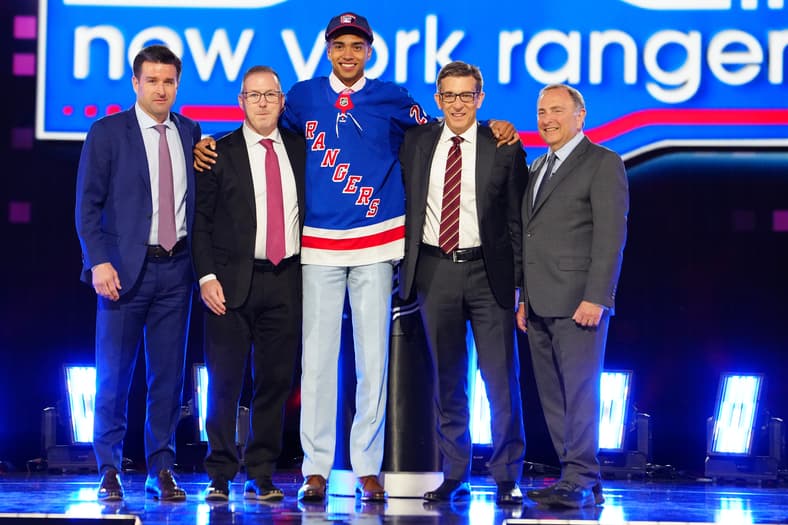
E.J. Emery (first round): Stock Down
Emery remains one of the biggest question marks in the Rangers’ system because the tools are there, but the results still aren’t. A first‑round pick shouldn’t be spending his sophomore season stuck on North Dakota’s third pair, yet that’s where he finished after showing only brief flashes of offense before going quiet for long stretches. His skating, reach, and defensive instincts still project NHL potential, but the lack of production and stalled role raise real concerns about his ceiling. The 20-year-old defenseman needs a breakout junior year to reestablish himself, because right now he looks more like a future third‑pair NHL defenseman than the impact blueliner his draft slot suggested.
Raoul Boilard (fourth round): Stock Down
Boilard never rediscovered the offensive touch he showed in his draft year, and his junior career reflected that inconsistency — he was traded twice in under a year and never fully settled into a top‑six role. The Rangers were unlikely to sign him this spring, but his move to Lake Superior State gives the organization four more years to evaluate him at the NCAA level. Despite the uneven season, the 20-year-old forward did finish strong with an excellent playoff run, leading Cape Breton in scoring and looking like their best player when it mattered most. The late surge was encouraging, but the overall body of work keeps his stock trending down.
Nathan Aspinall (fifth round): Stock Way Up
Aspinall is the clear choice as the Rangers Prospect of the Year after a monster breakout season that’s carried straight into the OHL playoffs. The Flint captain set career highs across the board with 33 goals, 61 assists, and 94 points, transforming himself from a fifth‑round long shot into one of the league’s most dominant forwards and a legitimate OHL MVP nominee. His game took a massive leap in pace, confidence, and finishing ability, driving Flint’s offense every night. This is a completely different player than a year ago — stronger, faster, more assertive — and the 20-year-old heads to Hartford of the American Hockey League next season looking like a real prospect, not a project.
2023 Draft Class
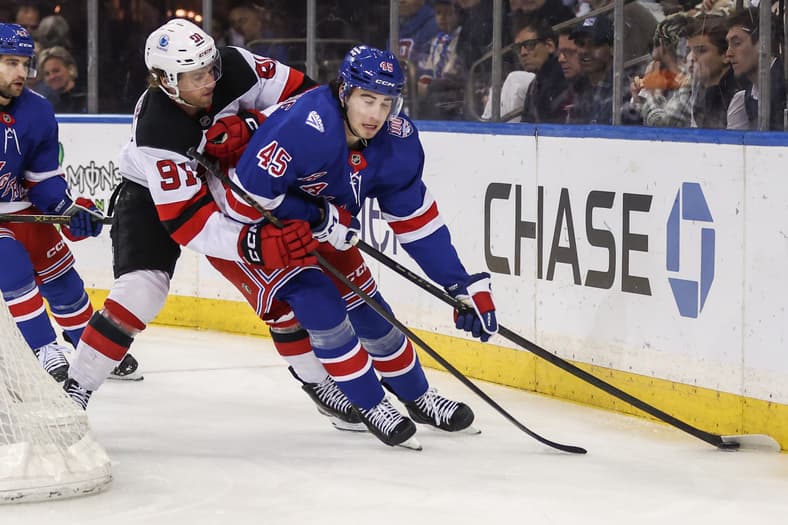
Drew Fortescue (third round): Stock Even
Fortescue’s season is tricky to judge because Boston College asked him to sacrifice offense for three straight years as the defensive anchor on their top pair, a role that limits his numbers but highlights his reliability. His NHL cameo with the Rangers is going well, but burning a year of his ELC instead of sending him to Hartford on an ATO raises real questions about whether it helps or slows his development. The 20-year-old still projects as a steady, defense‑first blueliner, but without a chance to expand his game at the AHL level this spring, it’s hard to say he took a meaningful step forward — which keeps his stock right where it was.
Rasmus Larsson (fifth round): Incomplete
Larsson gets a pass this season because injuries kept him off the ice far more than on it, limiting him to just 16 of Robert Morris’ 40 games, and preventing any real evaluation of growth. This is now his third year as a Rangers prospect, and the 22-year-old defenseman still hasn’t shown anything that suggests pro upside, which makes the lack of available reps even more concerning. New York holds his rights for two more years, but at this point there’s nothing in his body of work that indicates he’s trending toward an NHL contract. The only fair grade is incomplete — but the clock is ticking.
2021 Draft Class
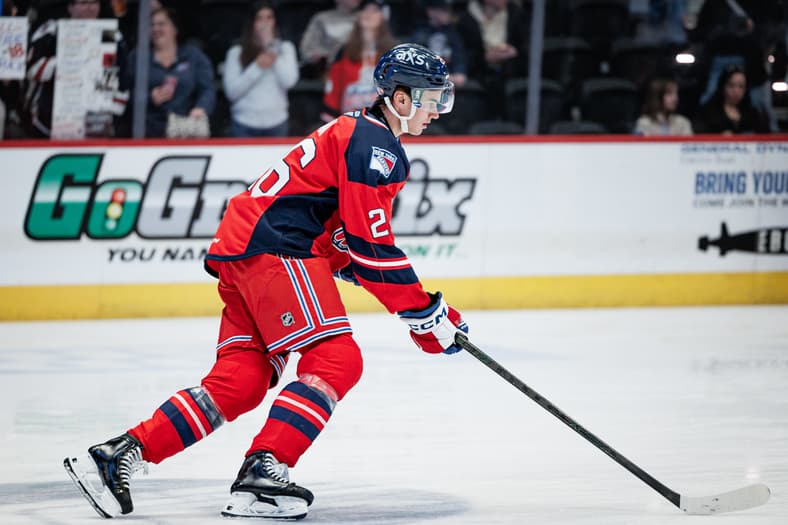
Brody Lamb — Photo courtesy Hartford Wolf Pack
Brody Lamb (fourth round): Stock Up Slightly
Lamb’s season is tough to judge because he spent the year on two struggling teams, but his late push nudges his stock upward. The 22-year-old forward posted career numbers at Minnesota with 30 points (14 goals, 16 assists) in 35 games, then went to Hartford and immediately delivered seven points (three goals, four assists) in his first 12 pro games, highlighted by a six‑game point streak that rescued what had been trending toward a “stock down” year. Lamb remains a natural goal scorer who can finish from anywhere, but consistency has been the missing piece throughout his five years as a prospect. With the Rangers desperate for offense, he’s going to get every chance to show he can translate that scoring touch at the pro level.
In-season acquisitions
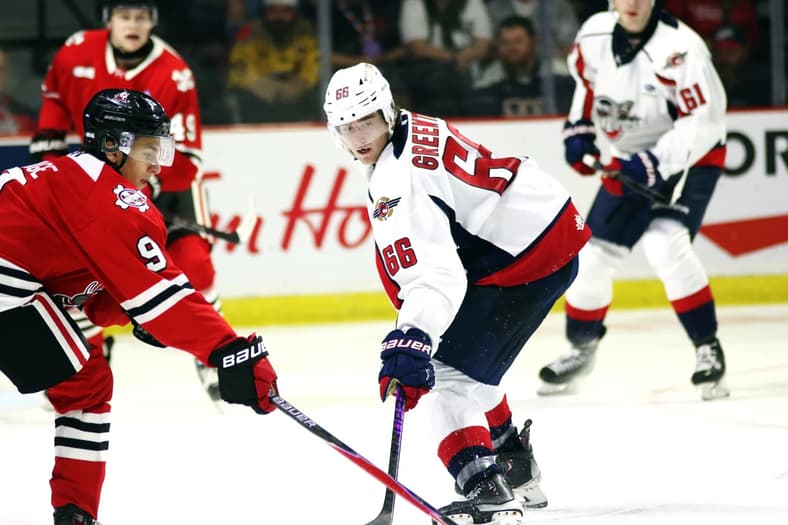
Liam Greentree – Photo courtesy OHL Images
Liam Greentree (originally 2024 first-round Los Angeles Kings): Stock Uncertain
Greentree is one of the most polarizing prospects in the Rangers system because the raw talent is obvious (119 points with Windsor of the OHL last season; 74 points this season), but the holes in his game are just as noticeable. He’s a gifted scorer who can beat goalies from anywhere and has the hands and touch to create offense on his own, yet concerns about his skating and defensive play dragged down his perceived value. The skating can be improved with time and development, but the defensive commitment will come down to how hard he’s willing to work. Opinions vary wildly — some see a future top‑six NHL winger, others see a third‑liner — but most evaluators currently project the 20-year-old as a third‑line NHLer unless he rounds out the rest of his game.
Jacob Battaglia (originally 2024 second-round Calgary Flames): Stock Uncertain
Battaglia is another prospect whose value depends on whom you ask, especially after the Calgary Falmes moved his rights in the Brennan Othmann trade. The scoring touch is real — he can beat goalies from anywhere and becomes a dangerous, big‑moment finisher once the playoffs start — but the concerns are just as real. He struggles on face-offs at the junior level, making it hard to project him as an NHL center, and his skating needs significant improvement before the 20-year-old forward can keep pace at the pro level. The talent is there, the shot is legit, and the playoff production with Flint is undeniable, but until the skating and center‑ice details catch up opinions on his long‑term upside will continue to vary.