Rangers have about $27 million to spend after NHL, players set salary cap

Not unexpectedly, the NHL and NHLPA announced Wednesday that the salary cap limit is $104 million per team next season. That sets up the New York Rangers to have the 11th most projected cap space, roughly $27 million per PuckPedia, ahead of this offseason.
The League and its players originally stated back on Jan. 31, 2025 that the expected salary cap for the 2026-27 season was $104 million, but allowed that it could be slightly higher or lower than that amount. The $8.5 million cap increase from last season is now confirmed and official.
The Rangers shed approximately $16 million from their payroll by trading Artemi Panarin and Carson Soucy this past season, and with the retirement of backup goaltender Jonathan Quick. They have two unrestricted free agents from the 2025-26 NHL roster, forwards Jonny Brodzinski and Conor Sheary, though neither made more than $787,500 last season.
Their most expensive in-house decision is re-signing restricted free agent defenseman Braden Schneider. That is if they don’t trade the 24-year-old this summer, considering how often his name comes up in the rumor mill.
Schneider earned $2.2 million last season and is two years away from becoming an unrestricted free agent. So, the Rangers could sign him to another bridge contract, the less expensive option, or invest in him longer term and buy out several of his UFA seasons. Even at that, Schneider’s contract isn’t expected to be over-the-top expensive.
Defenseman Vincent Iorio and possible No. 2 goalie Dylan Garand are also RFAs, but won’t cost nearly as much as Schneider. Garand, like Schneider, has arbitration rights, though far less service time in the NHL, of course.
New York’s current projected roster includes 20 signed players totaling $77.034 million in salary. No. 1 goalie Igor Shesterkin takes up the largest chunk of that financial outlay, earning $11.5 million in what will be the second season of his eight-year, $92 million contract. Defenseman Adam Fox is next at $9.5 million, followed by forwards Mika Zibanejad ($8.5 million), J.T. Miller ($8 million), and Alexis Lafreniere ($7.45 million). Fox’s defense partner Vladislav Gavrikov earns $7 million annually.
That projected roster also includes players like Matt Rempe, Adam Sykora, Jaroslav Chmelar, Adam Edstrom, Drew Fortescue, and Urho Vaakanainen — not all of whom will make the team out of training camp next season. So, New York’s projected salary cap space is actually a bit more than $27 million.
What Rangers can do with $27 million projected salary cap space
By recent standards, the Rangers are pretty flush with available cap space heading into this offseason. That provides more options for them this summer, though the free agent class isn’t exactly stacked with high-end talent, after Connor McDavid, Jack Eichel, Kirill Kaprizov, Martin Necas, and Kyle Connor re-signed with their current teams already.
The Rangers could pursue trades for the likes of Auston Matthews or Brady Tkachuk — even if Tkachuk shot down any notion he’s unhappy playing for the Ottawa Senators. More likely, the Rangers will target younger emerging NHL stars, especially if they trade Vincent Trocheck.
Perhaps the Rangers can best weaponize their available cap space by taking on a bad contract in order to acquire a more desirable player in the same trade. The Colorado Avalanche, Vegas Golden Knights, and Montreal Canadiens each have less than $10 million in projected cap space in 2026-27.
Of course, the Rangers aren’t the only team thinking about this option. The Pittsburgh Penguins have a whopping $45.08 million in projected cap space. Even with holes to fill on the roster, the Penguins are in a better spot than the Rangers, especially after making the Stanley Cup Playoffs this year.
The Anaheim Ducks ($40.15 million) and Philadelphia Flyers ($39.15 million) are two other younger teams loaded with available cap space that reached the postseason — and remain alive in the second round. The Washington Capitals are a team to watch, with a solid core, terrific coach in Spencer Carbery, and $36.56 million to spend — albeit with the uncertainty about Alex Ovechkin’s future.
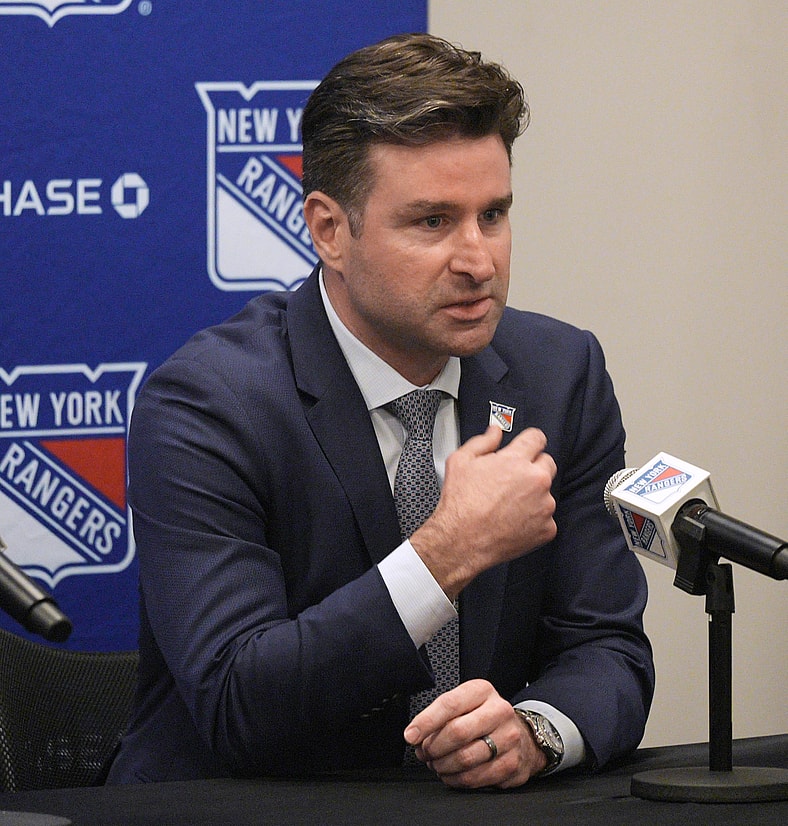
In other words, Rangers general manager Chris Drury absolutely has his work cut out for him this summer, though with the knowledge that the 2027-28 salary cap is expected to jump to $113.5 million.
The Rangers should be players in both the short game and the long game, thanks to financial flexibility, even tied to long-term contracts with 30-something stars like Shesterkin, Zibanejad, Miller, and Gavrikov.