Examining best lineup fits for Rangers newest star Pavel Dorofeyev

It’s been a busy and largely fruitful offseason, so far, for the New York Rangers. And it’s probably safe to say that the acquisition of Pavel Dorofeyev from the Vegas Golden Knights in a draft-day trade that kicked off this wild stretch June 26 still has Rangers fans crowing and the front office collectively slapping itself on the back.
The Rangers get high marks for landing a young star who puts the puck in the net more often than most players in the League, then signing him to a monster seven-year, $77 million contract. How to put the 25-year-old winger in the best position to maximize his vast potential is what lies ahead for coach Mike Sullivan and general manager Chris Drury.
That’s because Dorofeyev, who led Vegas with 37 goals last season after pouring in 35 the year prior, is not regarded as a play-driver in his own right. His effectiveness comes from elite finishing skill, which is succinctly illustrated by numerous impreessive metrics.
The third-round pick by Vegas in the 2019 draft had the incredibly good fortune to play with Jack Eichel and Mitch Marner, two of the League’s top possession drivers and distributors. While it’s crucial to note that Dorofeyev’s numbers playing without both players at 5-on-5 were still quite good the past two seasons, he clearly benefited when paired up with the two stars.
Dorofeyev and Eichel produced a 62.2 percent expected goal share at 5-on-5 over the past two seasons, including 67.2 percent last season, per Natural Stat Trick. The pair didn’t spend a ton of time on ice together at even strength – just 295:22 over both seasons, as opposed to 1922:31 apart – and Dorofeyev posted a strong 55.7 mark without Eichel during that time. Still, there’s a significant difference between the two, showing just how much Dorofeyev’s play was enhanced by Eichel’s presence.
Dorofeyev only played one season with Marner, posting a 57.3 percent expected goal share with him in 605:21 at 5-on-5, and a 56.5 mark without the superstar on the same line – largely similar results. It follows, though, that more time together with perhaps the most effective passer in the League would likely lead to that gap widening.
The Rangers struggled to generate offense at 5-on-5 last season, continuing a recurring problem for them. The addition of Dorofeyev to the top power-play unit – his 20 goals with the man advantage last season were second-most in the NHL – should make the Blueshirts’ already-dangerous power play (No. 5 in the League in 2025-26) more fearsome. But Dorofeyev’s new team must figure out how to maximize his offensive gifts at even strength.
A big key is picking the right linemates for Dorofeyev. Without the benefit of training camp or actual games yet, the approach to integrating Dorofeyev seems to boil down to three clear options.
1. Rangers can break up top line, place Dorofeyev with Zibanejad, Perreault
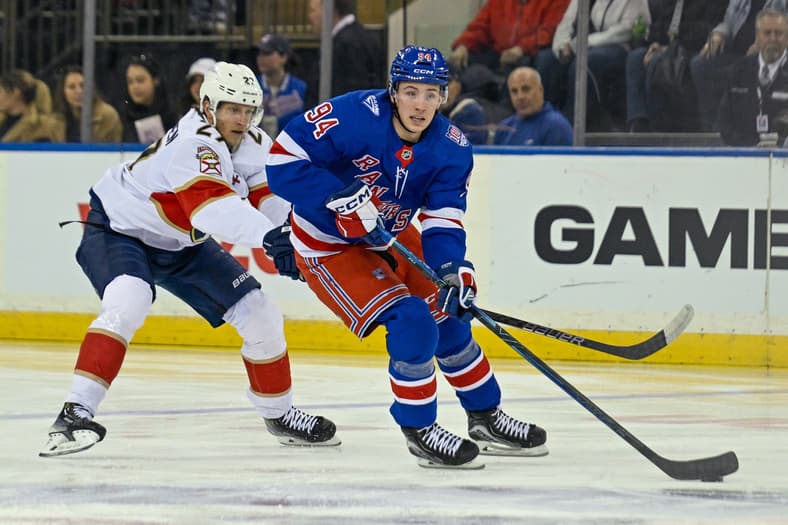
The Rangers don’t possess a player like Eichel or Marner, but Drury’s quick to point out that they do have some decent talent to complement their new star.
“I think we’ve got some pretty talented players that can get him the puck as well, whether it’s 5-on-5 or power play,” New York’s GM told reporters Thursday.
Topping that list is Mika Zibanejad, the 33-year-old-center who led the Rangers with 34 goals, 44 assists, and 78 points last season, and is the franchise’s seventh leading scorer all-time (667 points in 730 games wearing the Blueshirt). There’s also Adam Fox, an elite puck-moving defenseman and former Norris Trophy winner, and Sean Durzi, whom the Rangers acquired from the Utah Mammoth to also distribute the puck from the blue line and help the Rangers break out and get to their transition game more easily.
The idea of putting Dorofeyev on the wing next to Zibanejad makes a lot of sense. Especially if Gabe Perreault mans the other wing. The 21-year-old displayed elite vision, passing skills, and Hockey IQ as a rookie last season, especially down the stretch when elevated to a top-line role with Zibanejad and Alexis Lafreniere.
The thought of Perreault’s passes enabling Dorofeyev’s hard, wicked shots is tantalizing, to say the least.
But, do the Rangers want to mess with success? The Perreault-Zibanejad-Lafreniere unit was a revelation after Sullivan assembled it in early March, with the trio outscoring opponents 14-10 and outchancing them 124-113 at 5v5 – including 51-45 in high-danger chances – in the final 22 games. Perreault’s addition to that line, in fact, played a key role in Lafreniere’s corresponding surge. Lafreniere recorded 14 goals and 14 assists over his final 27 games – one of his best stretches in the NHL.
It should be pointed out that Lafreniere drove play consistently all season – but scored much more with Perreault as his linemate. Lafreniere finished with 24 goals and 33 assists and equaled his career high with 57 points. Sullivan and the Rangers, desperate to unlock consistent production from the 2020 No. 1 overall pick, must tread carefully before fixing something that wasn’t broken.
2. Rangers could spread wealth, put Dorofeyev on same line with Miller
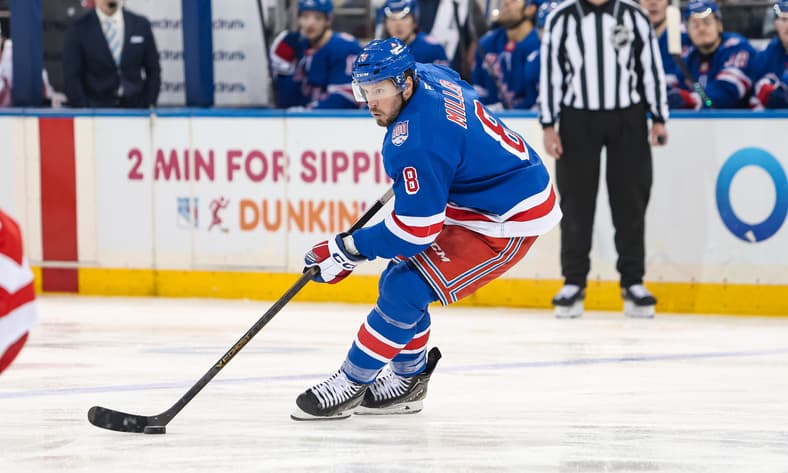
This option allows the Rangers to keep one productive top-six forward trio together while forging a second one, with Dorofeyev joining a presumably healthy and motivated J.T. Miller as his center. Miller’s difficult and injury-marred 2025-26 season somewhat obscures the fact that he averaged better than a point per game from 2021-22 through 2025-26. Miller played only 68 games last season and totaled 53 points, but in the three seasons before that, he recorded more than 60 assists twice and hit 50 another time. The Rangers acquired the 33-year-old during the 2024-25 season in large part for his ability to lift his teammates offensively. The Rangers won’t know if the pairing works unless they try.
Miller, who piled up 99, 82 and 103 points from 2021-24, could also return to his previous scoring levels with Dorofeyev on his wing. In theory, Dorofeyev is able to find the open spaces created by the powerful Miller when he carries the puck into the offensive zone. Like many elite goal scorers, Dorofeyev excels at doing just that – getting into advantageous positions to receive a pass and then shoot. Miller’s game could perfectly complement Dorofeyev’s, much like space creators Eichel and Marner did in Vegas, with the Rangers captain drawing defenders and finding Dorofeyev for high-danger scoring opportunities.
Such a scenario will only become reality if Miller is healthy and effective, and if 2025-26 wasn’t a red flag that his game is beginning to decline. If last season proves to be a one-off for Miller, the Rangers could have a dynamic duo whose theoretical synergy energizes the offense of both players.
In this scenario, recently-signed veteran Oliver Bjorkstrand could be the third man on the line. Or perhaps Will Cuylle plays on the other wing to do more of the dirty work and allow Dorofeyev even more room to operate in the offensive zone.
3. Rangers could fire up line blender, begin with clean slate at training camp
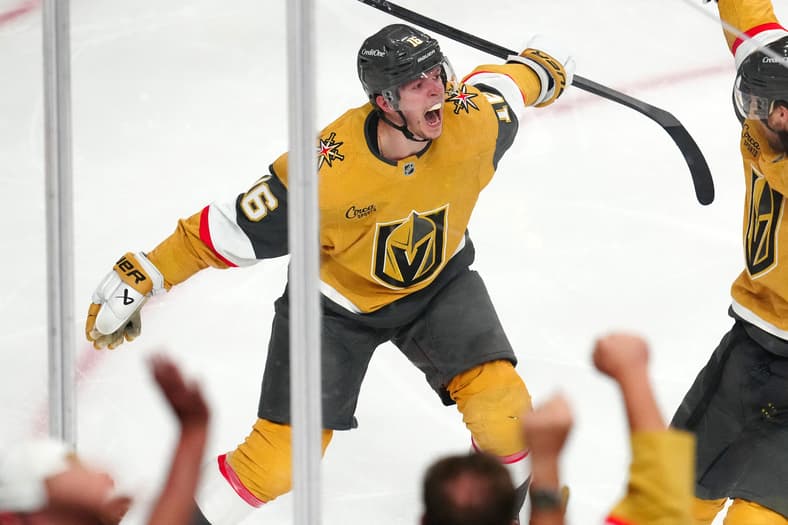
The Rangers could just start from scratch when camp convenes in September by trying Dorofeyev with a variety of potential linemates and seeing what works. In paying him an average of $11 million per season through 2032-33, the team committed to Dorofeyev as its long-term offensive anchor. This option provides a chance to figure out the ideal fit for its new star, rather than approaching it as having to “find a place” for him in a largely established top six.
Given the Rangers’ offensive struggles and difficulty at even strength last season, the reasoning is that nothing – not even a combining of three core forwards into a successful unit – needs to be held sacred from a team that finished last in the Eastern Conference.
Sullivan surely doesn’t want to ignore what he learned about Perreault, Zibanejad and Lafreniere in 2025-26, but the coach didn’t win two Stanley Cup championships and an Olympic gold medal by being stubborn and lacking creativity with his lineups. It’s unlikely he’ll start to behave that way now by declaring any course of action off the table, especially after a season in which his club cratered in the standings.
However Sullivan chooses to proceed, there’s no question that the top priority on offense next season is to help Dorofeyev score 30-plus goals yet again – preferably even more. The Rangers coach gets paid the big bucks precisely to figure out how to do so. He’ll have multiple opportunities this fall — and throughout the 2026-27 season — to get it right